

Views: 0 Author: Site Editor Publish Time: 2026-04-20 Origin: Site


Commercial flooring is undergoing a massive shift. Designers are rapidly moving away from traditional wall-to-wall broadloom and rigid hard surfaces. Instead, they increasingly favor adaptable, modular solutions. Modern commercial environments require spaces built for constant evolution. Rigid infrastructure simply slows progress down.
Selecting the right flooring is no longer just an aesthetic calculation. Facility managers, architects, and business owners face complex operational challenges. They must evaluate project downtime, maintenance overhead, and long-term asset flexibility. Disruptive renovations hurt workplace productivity. Replacing entire floors due to localized stains disrupts maintenance planning.
We will explore an evidence-based framework for evaluating Modular Carpet Tiles. You will discover practical insights into installation efficiency, maintenance realities, and functional design. We will also unpack the critical specification standards necessary for making a qualified procurement decision. This guide helps you navigate past marketing myths to understand real-world performance.
Operational Continuity: Modular installation slashes project downtime, allowing for phased, furniture-in-place installations.
Predictable Long-Term Performance: Material waste drops to 1–3% (compared to 5–25% for broadloom), while advanced backing technologies reduce long-term deep-cleaning demands.
Risk Mitigation: Specifying mergeable patterns and solution-dyed fibers prevents the common pitfall of dye-lot mismatch during single-tile replacements.
Compliance Ready: Transitioning to PVC-free and bitumen-free backings aligns with emerging commercial building legislation and Digital Product Passport requirements.
Evaluating commercial flooring strictly on its cost per square foot is a common trap. This narrow metric completely ignores installation labor, business interruption, and material waste. A true evaluation demands looking at the full lifecycle of the flooring choice. Buyers must account for what happens during the installation phase and over the next decade.
Material waste metrics present a stark contrast between flooring types. Standard broadloom carpet typically suffers from a 5–25% installation waste rate. Installers must cut large, continuous rolls to fit irregularly shaped commercial spaces. You pay for material heading straight to the dumpster. In contrast, Modular Carpet Tiles boast an incredibly efficient 1–3% waste factor. Installers only cut the perimeter tiles. The core of the room uses whole squares, maximizing every unit of material.
The zero downtime advantage dramatically shifts the project equation for operating businesses. Traditional renovations require emptying a room completely. You must dismantle cubicles, disconnect IT infrastructure, and halt operations. Modular flooring changes this paradigm entirely. Installers utilize specialized hydraulic lift systems for office furniture. They raise fully loaded desks slightly off the ground, remove the old flooring, and slide the new squares underneath. You avoid full-scale shutdowns. You also bypass expensive weekend or overnight labor demands.
However, we must manage subfloor preparation expectations. Modular formats are generally forgiving. Yet, extreme subfloor irregularities still require professional leveling. Bumps or deep cracks will eventually telegraph through the surface. Proper preparation ensures long-lasting visual integrity.
Metric | Traditional Broadloom | Modular Carpet Tiles |
|---|---|---|
Material Waste | 5% – 25% | 1% – 3% |
Business Interruption | High (Requires furniture removal) | Low (Furniture lifting systems applicable) |
Installation Speed | Slower (Heavy rolls, complex seaming) | Faster (Easy handling, phased layout) |
Subfloor Tolerance | Moderate (Requires heavy padding) | High (Built-in dimensional stability) |
Marketers often claim you can easily swap out a single stained tile. Facility managers know this is rarely true. Real-world conditions quickly complicate simple replacements. UV light exposure causes gradual fading over time. Normal foot traffic flattens the pile slightly. If you drop a brand-new square directly into a five-year-old floor, it stands out glaringly. This dye-lot dependency ruins the visual harmony of your space.
You can prevent this mismatch through smarter specification. Always prioritize solution-dyed fibers over piece-dyed options. Manufacturers add the color pigment directly into the liquid polymer before extruding the fiber. The color becomes an inherent part of the material. Solution-dyed nylon resists UV fading and harsh cleaning chemicals significantly better. Additionally, you should specify non-directional or mergeable patterns. These random installation designs lack a rigid geometric flow. New replacement sections blend visually without requiring a strict dye-lot match.
Experienced facility managers employ a clever rotation method to extend flooring life. The 80/20 rule dictates that 20% of your floor endures 80% of the footfall. Follow these steps to maximize your maintenance planning:
Identify heavily soiled tiles in high-traffic corridors or lobby entrances.
Locate hidden, pristine tiles of the exact same age under desks or inside storage closets.
Extract the worn tiles from the traffic lanes.
Swap the hidden tiles into the high-traffic areas.
Install your brand-new replacement stock in the hidden zones where visual mismatch does not matter.
We must also examine the technical difference in backing technologies. Spills behave differently depending on the structure beneath the fiber. Traditional broadloom permits liquids to seep deep into the underlying pad. When you steam clean the surface, capillary action pulls the trapped spill back up. This phenomenon causes stains to wick back to the surface weeks later. High-density, impermeable modular backings solve this. They trap spills at the surface layer. Cleaning crews can extract the liquid quickly and permanently.
Modern office design currently suffers from an industrial design flaw. Exposed concrete ceilings, glass partitions, and Luxury Vinyl Tile (LVT) floors dominate corporate aesthetics. While visually striking, these rigid surfaces create severe acoustic and ergonomic challenges. Sound waves bounce endlessly across hard planes. Ambient reverberation spikes, causing conversational distraction. Employees report higher fatigue levels from standing and walking on unforgiving concrete.
Effective acoustic management requires soft surfaces. Modular carpet tiles effectively dampen impact noise from footfalls and dropped objects. They also absorb ambient airborne sounds, lowering the overall reverberation time in open spaces. You achieve a quieter, more focused working environment. Best of all, you achieve this without investing in expensive drop-ceiling acoustic baffles or wall-mounted sound panels.
Designers do not have to sacrifice modern architectural aesthetics for acoustic comfort. Today’s hybrid aesthetics bridge the gap perfectly. Manufacturers now offer Modular Carpet Tiles in narrow planks and atypical geometric shapes. You can mimic the linear, sleek look of wood or polished stone flooring. You get the desired architectural visual while maintaining the ergonomic cushioning and acoustic absorption of a soft textile.
Consider the daily physical toll on staff. Nurses, retail workers, and teachers spend hours on their feet. Hard floors contribute to joint pain and lower back stress. The integrated cushion backing found in high-quality modular options provides critical micro-compression. It absorbs kinetic energy during walking. This minor ergonomic adjustment yields significant improvements in occupant comfort and productivity.
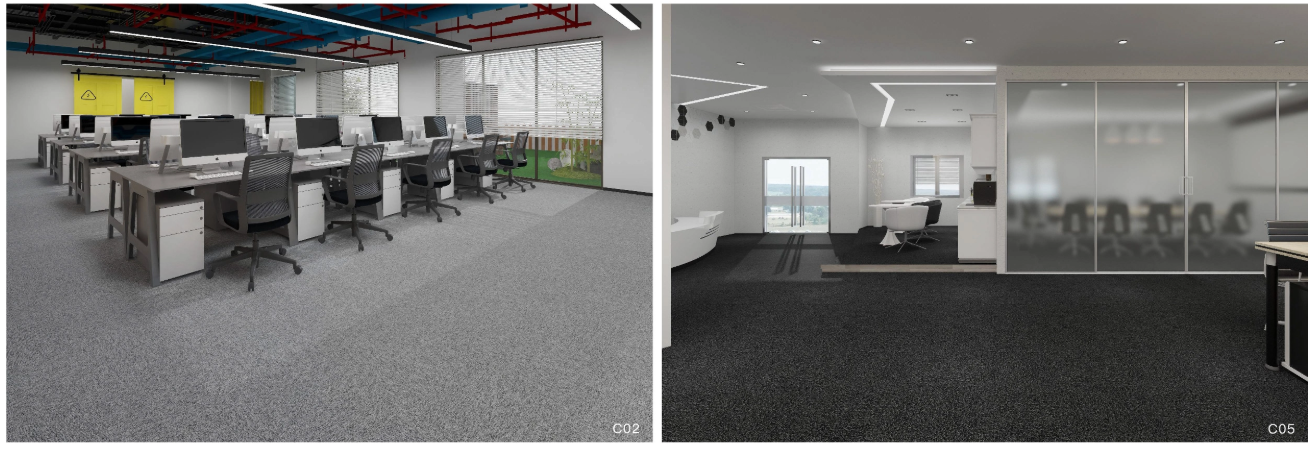
Open-plan spaces offer incredible collaboration potential. However, they easily become chaotic without clear visual boundaries. Flooring serves as a powerful, subconscious organizational tool. You can create distinct zoning without building a single physical wall. Contrasting colors and varied textures guide behavior naturally.
Strategic flooring patterns act as built-in wayfinding mechanisms. A vibrant, highly textured path can signify a primary circulation corridor. When employees step off the textured path onto a softer, muted color palette, they intuitively understand they have entered a quiet work zone. You can use dynamic geometric patterns to highlight collaborative hubs or cafeteria spaces. This visual psychology organizes movement and reduces workplace friction.
This functional design approach relies heavily on scalability. Corporate needs change rapidly. A team might outgrow its designated area. A company might need to convert a breakout lounge into additional desk space. Modular flooring accommodates these shifts effortlessly. You do not need to tear out entire sections of flooring to redefine the space.
Effortless Reconfiguration: Pull up specific color blocks and move them to a new location to redraw department boundaries.
Cost-Effective Updates: Refresh the look of a lobby by swapping out just the accent colors rather than replacing the entire floor.
Safety Designations: Use brightly colored inserts to designate emergency exit paths or restricted areas near machinery.
Agile spaces demand agile materials. Companies no longer want static environments. They want living offices that adapt to headcounts and project phases. The modular format guarantees your floor plan remains as flexible as your workforce.
Selecting commercial materials requires strict adherence to performance metrics. You cannot rely on marketing brochures alone. Buyers must verify authoritative certifications to ensure longevity and safety. Understanding European and Global standards empowers you to make defensible procurement choices.
Always check the EN 1307 classification. This standard dictates the suitability of textile floor coverings. For corporate offices, airports, or schools, you must demand a Class 33 rating. Class 33 certifies the product for heavy commercial use. Lower ratings will degrade rapidly under intense foot traffic. Furthermore, ask manufacturers for their Vettermann Drum Test (ISO 10361) results. This rigorous mechanical test involves a heavy steel ball rolling continuously inside a rotating drum lined with the carpet. It accurately measures appearance retention and crush resistance over time. High scores here guarantee the pile will not flatten out after a few months.
Material health and off-gassing present another critical compliance hurdle. Historically, manufacturers used bitumen and PVC for heavy floor backings. These materials emit Volatile Organic Compounds (VOCs) and contribute to poor indoor air quality. The industry is aggressively shifting toward healthier alternatives. Leading producers now utilize recycled PET (derived from discarded water bottles) to create felt backings. These bio-based and recycled alternatives drastically lower VOC emissions. They protect occupant health while keeping plastic out of oceans.
Finally, we must consider end-of-life protocols and circularity. Global legislation increasingly targets construction waste. The European Union is pioneering Digital Product Passports (DPP). Forward-thinking manufacturers embed scannable codes directly onto the tile backing. These digital passports track the material's origin, chemical composition, and exact age. When a facility manager scans the code ten years later, they instantly access closed-loop recycling instructions. The materials return to the manufacturer for reprocessing rather than ending up in a local landfill. Specifying DPP-enabled products future-proofs your building against upcoming environmental regulations.
Transitioning from traditional broadloom or rigid hard surfaces to modular solutions is a strategic operational decision. It is less about chasing aesthetic trends and more about rigorous risk management. You actively reduce operational downtime during installation. You simplify facility maintenance through smart rotation strategies and superior stain management. Most importantly, you gain an adaptable asset that evolves alongside your organizational needs.
Before shortlisting vendors, take actionable next steps. Always request comprehensive performance specification sheets. Scrutinize the documents for solution-dyed fibers and a certified Class 33 commercial rating. Calculate your overall 10-year maintenance and replacement planning, factoring in zero-downtime installation benefits. By demanding verifiable performance metrics and sustainable backing technologies, you secure a flooring solution that protects your business operations well into the future.
A: Seam visibility depends heavily on the pile type and pattern. Non-directional, highly textured loop tiles hide seams almost entirely, creating a unified look. Conversely, solid, flat-color cut pile tiles may show a subtle grid. Specifying heavily patterned or mergeable designs is the best way to conceal seams.
A: Yes, they perform exceptionally well under rolling loads provided the backing is dimensionally stable and installed correctly. Installers often utilize pressure-sensitive adhesives to prevent lateral shifting. Always check the manufacturer's specific caster-chair testing ratings before specifying for intensive rolling traffic areas.
A: The raw material itself may carry a higher per-square-foot price tag. However, you must evaluate the fully installed picture. Modular options have drastically lower installation waste (1-3% versus up to 25%). Combined with significantly reduced installation labor hours, the final installed scope is highly competitive.


