

| Color: | |
|---|---|
| Size: | |
| Fiber: | |
| Backing: | |
| Gauge: | |
| Construction: | |
| Total Thickness: | |
| Quantity: | |
Leader
LKHY

Choosing carpet tiles for a commercial project is not simply about selecting a color or pattern.
For contractors, distributors, project purchasers and flooring specialists, the more important questions usually come later:
Will the specification fit the intended application?
Is the product practical for installation and future maintenance?
Can the supplier support consistent production for a project order?
Leader is a 50 × 50 cm commercial carpet tile developed with a multi-level loop construction, polypropylene fiber and Ecological backing. Its structure is designed for commercial interiors where buyers need a practical modular flooring option for project-based applications.
The product can be considered for offices, hospitality interiors, public buildings and other commercial spaces, depending on the specific project requirements.
| Item | Specification |
|---|---|
| Style | Leader |
| Construction | Multi-Level Loop |
| Fiber | PP (Polypropylene) |
| Gauge | 1/10" |
| Backing | Ecological Backing |
| Pile Height | 5 / 3 / 2 ±0.5 mm |
| Tile Size | 50 × 50 cm |
| Product Type | Commercial Carpet Tile |
The stepped pile-height structure is one of the main features of this product. Rather than presenting a completely uniform carpet face, the different pile levels create visible changes in texture across the surface.
Commercial flooring is exposed to a very different environment from residential flooring.
In offices, hotels and public buildings, the floor may be used continuously by employees, visitors and customers. At the same time, contractors and facility managers also need to consider installation efficiency and future maintenance.
This is where carpet tiles offer a practical alternative to traditional broadloom carpet.
Leader is supplied in a 50 × 50 cm modular format, allowing the flooring to be installed tile by tile. For project buyers, this modular construction can be useful when planning installation, maintenance and future replacement.
Instead of automatically replacing a large continuous area because of a localized problem, individual sections may be addressed at the tile level when appropriate.
For commercial facilities, this can make long-term flooring management more flexible.
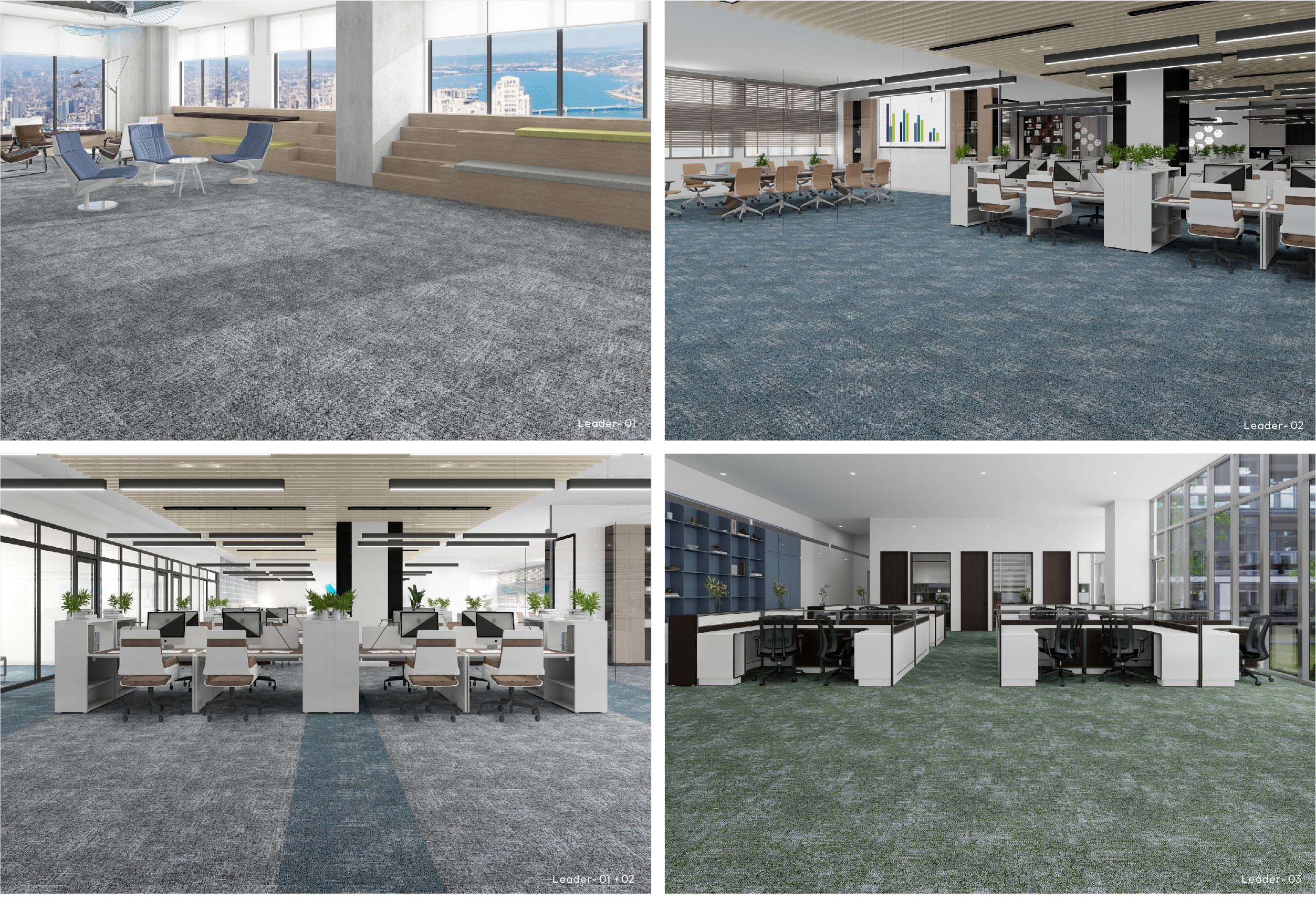
One of the main characteristics of Leader is its Multi-Level Loop construction.
The pile is formed at different heights:
approximately 5 mm
approximately 3 mm
approximately 2 mm
with the stated production tolerance of ±0.5 mm.
This creates a surface with more texture than a completely flat carpet face.
The multi-level surface introduces variation into the appearance of the carpet.
Instead of relying entirely on printed graphics or highly complex patterns, the different pile levels create visual depth through the carpet construction itself.
This can be useful for commercial interiors where buyers are looking for a professional flooring appearance without making the overall space feel overly decorative.
Flooring is usually only one part of a larger interior project.
The carpet can be coordinated with:
workstation systems
office furniture
wall finishes
meeting room interiors
partition colors
reception areas
The final selection should always be based on the actual color and design requirements of the project.
Many commercial interiors require a balance between appearance and practicality.
The textured surface of a multi-level loop carpet provides a different visual option from a plain, uniform carpet face.
For designers and project buyers, this offers more flexibility when planning the overall flooring scheme.
Leader uses PP, or polypropylene, fiber.
For B2B buyers, fiber selection should always be considered together with the intended application, project budget and maintenance requirements.
Polypropylene is commonly used in carpet production and can provide a practical option for commercial projects.
However, professional buyers should avoid selecting a carpet based on fiber type alone.
The overall performance of a carpet tile is influenced by several factors, including:
pile construction
fiber structure
backing system
pile height
installation method
traffic conditions
cleaning and maintenance practices
For this reason, a commercial carpet tile should be evaluated as a complete flooring product rather than by looking at only one specification.
Leader is manufactured with a 1/10" gauge.
Gauge is one of the construction specifications used to describe the arrangement of the carpet structure.
For professional buyers comparing different carpet tile products, it is useful to review gauge together with other specifications rather than using it as a standalone purchasing factor.
For example, two carpet tiles may have the same gauge but differ in:
fiber type
backing
pile height
surface pattern
overall construction
When comparing products from different suppliers, buyers should request the complete technical specification.
This helps ensure that products are being compared on a more consistent basis.
The backing is an important part of a carpet tile.
It supports the carpet structure and is part of the overall flooring system used in a commercial installation.
Leader is supplied with Ecological Backing according to the provided product specification.
For project procurement, buyers should confirm the backing requirements before placing an order, particularly when the project has specific requirements related to:
subfloor conditions
installation methods
adhesive compatibility
moisture conditions
project specifications
local building requirements
The carpet tile itself is only one part of the finished flooring system.
Subfloor preparation and installation conditions can also influence the final installation result.
For this reason, flooring contractors should confirm the appropriate installation method before beginning a large-scale project.
The 50 × 50 cm carpet tile format provides a practical modular size for many commercial flooring projects.
Each tile covers:
This makes quantity planning relatively straightforward.
Project area ÷ 0.25 m² = approximate number of tiles required
For example:
A 100 m² installation area requires approximately:
In an actual project, additional material may be required for:
cutting
layout adjustments
installation losses
future replacement stock
The final quantity should be determined according to the actual site layout and installation plan.
One reason many commercial buyers choose carpet tiles is their modular structure.
Commercial buildings do not always experience the same level of use across every area.
Some zones may receive more daily traffic, including:
entrances
corridors
circulation areas
areas around workstations
meeting room entrances
With modular carpet tiles, facility managers can plan maintenance around specific areas instead of automatically treating the entire floor as one continuous piece of flooring.
This does not remove the need for regular cleaning and maintenance, but it can provide more flexibility when dealing with localized areas.
For larger projects, buyers may also consider keeping an appropriate quantity of spare tiles from the original order.
This can be useful for future replacement planning, especially when the same color or production batch is important to the project.
Leader commercial carpet tiles can be considered for different interior commercial applications, depending on the final project requirements.
The modular format can be considered for:
open-plan offices
private offices
meeting rooms
collaborative spaces
administrative areas
For office refurbishment projects, carpet tiles can be particularly practical when installation and future maintenance both need to be considered.
Hospitality projects often require flooring that works with a coordinated interior design scheme.
Depending on the technical requirements of the project, carpet tiles may be considered for:
business centers
meeting facilities
administrative offices
selected interior commercial areas
For hotel projects with specific fire, acoustic or design requirements, buyers should confirm the complete technical specification before approval.
Commercial developments often involve several decision-makers during the flooring selection process, including:
developers
architects
interior designers
general contractors
flooring contractors
procurement teams
A clear product specification can make communication between different parties easier.
Leader provides defined construction information that buyers can review when comparing carpet tile options for a project.
Educational and public buildings may involve large installation areas and long-term maintenance requirements.
Before selecting a carpet tile, buyers should evaluate:
expected foot traffic
maintenance requirements
project budget
installation conditions
local technical requirements
The product should be matched with the actual project environment rather than selected based only on appearance.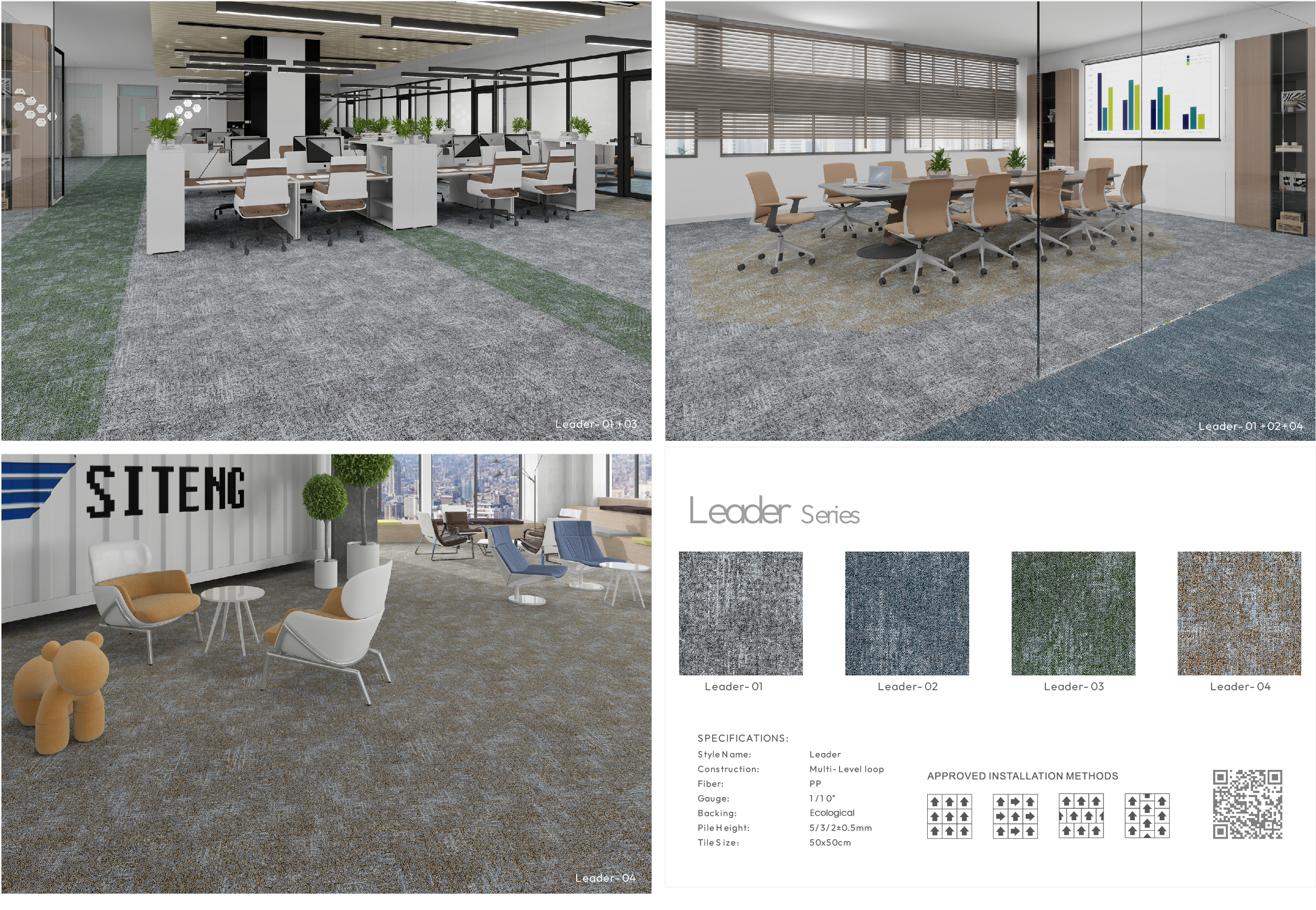
When sourcing carpet tiles for a commercial project, price is important—but it should not be the only point of comparison.
Professional buyers should normally review several key areas before confirming a supplier.
Ask for clear information about:
fiber type
construction
gauge
pile height
backing
tile dimensions
For Leader, the main specifications are:
PP fiber, Multi-Level Loop construction, 1/10" gauge, Ecological Backing and a 50 × 50 cm tile size.
Reviewing the complete specification helps buyers understand what they are purchasing.
Not every commercial carpet should automatically be used in the same environment.
Before selecting a product, buyers should identify:
expected foot traffic
installation area
furniture type
rolling traffic
cleaning frequency
maintenance conditions
A product that is appropriate for one area of a building may not necessarily be the best option for another.
Projects in different countries and markets may have different requirements.
These can include:
fire performance
smoke requirements
environmental requirements
project-specific documentation
If a project requires a particular test standard or classification, buyers should provide the exact requirement during the quotation or product approval stage.
The product and available documentation can then be checked against the project's requirements.
This is more reliable than assuming that one general specification automatically meets every country's regulations.
Carpet tile projects should include consideration for future maintenance.
Professional buyers may wish to consider:
ordering spare tiles
keeping records of approved colors
recording production information
storing replacement materials properly
This can be particularly useful for large projects or developments completed in multiple phases.
For international B2B procurement, communication is an important part of the purchasing process.
Before confirming a large order, buyers should normally clarify:
final specifications
product approval
color requirements
order quantity
production schedule
packaging requirements
shipping arrangements
inspection requirements
Clear communication before production can help reduce unnecessary changes later.
Commercial projects do not always follow a standard purchasing model.
A distributor may need a particular product configuration for its market.
A contractor may need samples and specifications for a tender.
A project developer may need to coordinate flooring with a wider interior design plan.
For these situations, the purchasing discussion should begin with the actual project requirements.
Before customization or bulk production, buyers can provide information such as:
project application
project country
estimated quantity
preferred color or design
technical requirements
expected delivery schedule
The feasibility of a specific design or configuration should always be confirmed before production.
The Middle East is an important market for commercial and hospitality construction projects.
However, the region should not be treated as a single market with identical technical requirements.
Requirements may vary according to:
country
city
building type
project specification
consultant requirements
For projects requiring fire-related documentation, buyers should provide the exact requested standard or classification.
Share information about the project location, application and technical requirements.
Review the fiber, construction, backing, dimensions and other relevant product information.
Clarify what testing reports or documents are specifically required by the project.
For larger projects, physical sample approval can help ensure that expectations regarding appearance and construction are clear.
The final approved specification should be clearly confirmed before bulk manufacturing begins.
This approach is generally more reliable for B2B project procurement than relying only on broad product descriptions.
Leader is a commercial carpet tile featuring PP fiber, Multi-Level Loop construction, Ecological Backing and a 50 × 50 cm modular format.
Its suitability for a specific project should be evaluated according to the application, expected traffic and technical requirements.
The different pile heights create a more textured surface compared with a completely uniform carpet face.
This gives the flooring a structured appearance and provides another design option for commercial interiors.
According to the provided product specification, Leader carpet tiles use Ecological Backing.
For specific projects, buyers should confirm that the product configuration meets the installation and technical requirements of the project.
The 50 × 50 cm format provides a practical modular size for commercial flooring.
Each tile covers 0.25 m², which makes quantity estimation straightforward.
One advantage of a modular carpet system is that localized areas can potentially be addressed without replacing the entire floor covering.
The actual replacement process depends on the installation condition and the availability of matching replacement tiles.
The suitability of a carpet tile depends on the actual traffic conditions and the technical requirements of the project.
For high-use environments, buyers should evaluate the complete product specification together with the expected application and maintenance conditions.
If a project has defined performance requirements, these should be confirmed during the sourcing process.
For customized or project-based orders, buyers can provide information about the required design, color, application and quantity.
The feasibility of a particular requirement should be confirmed before production.
Leader can be evaluated for commercial projects in Middle East markets.
However, the final product specification should be checked against the exact requirements of the individual project.
If fire testing or other technical documentation is required, buyers should provide the specific standard requested by the project.


