

STAR/MOON
LKHY
For commercial flooring projects, the choice of carpet tile is not only about color or appearance. Project buyers usually need to consider material consistency, installation requirements, replacement planning, cleaning, delivery schedules and the overall suitability of the flooring system for the intended space.
These PP carpet tiles are designed for buyers looking for a practical modular flooring option for offices, commercial interiors and other project-based applications.
The product uses polypropylene fiber with a level loop construction. The standard tile size is 50×50cm, making it convenient for quantity calculation, layout planning and phased installation.
Instead of purchasing a large roll of carpet and replacing an entire section when damage occurs, carpet tiles allow the flooring system to be managed in smaller modules. This can be useful for commercial properties where different areas may experience different levels of daily use.
| Specification | Details |
|---|---|
| Product Type | PP Carpet Tiles |
| Size | 50×50cm |
| Color / Style | STAR01 |
| Fiber | Polypropylene (PP) |
| Construction | Level Loop |
| Gauge | 1/10" |
| Pile Height | 3mm |
| Total Thickness | 5±1mm |
| Application | Commercial and Project Flooring |
| Customization | Available according to project requirements |
Note: Backing information should be confirmed according to the final production specification before quotation or bulk production.


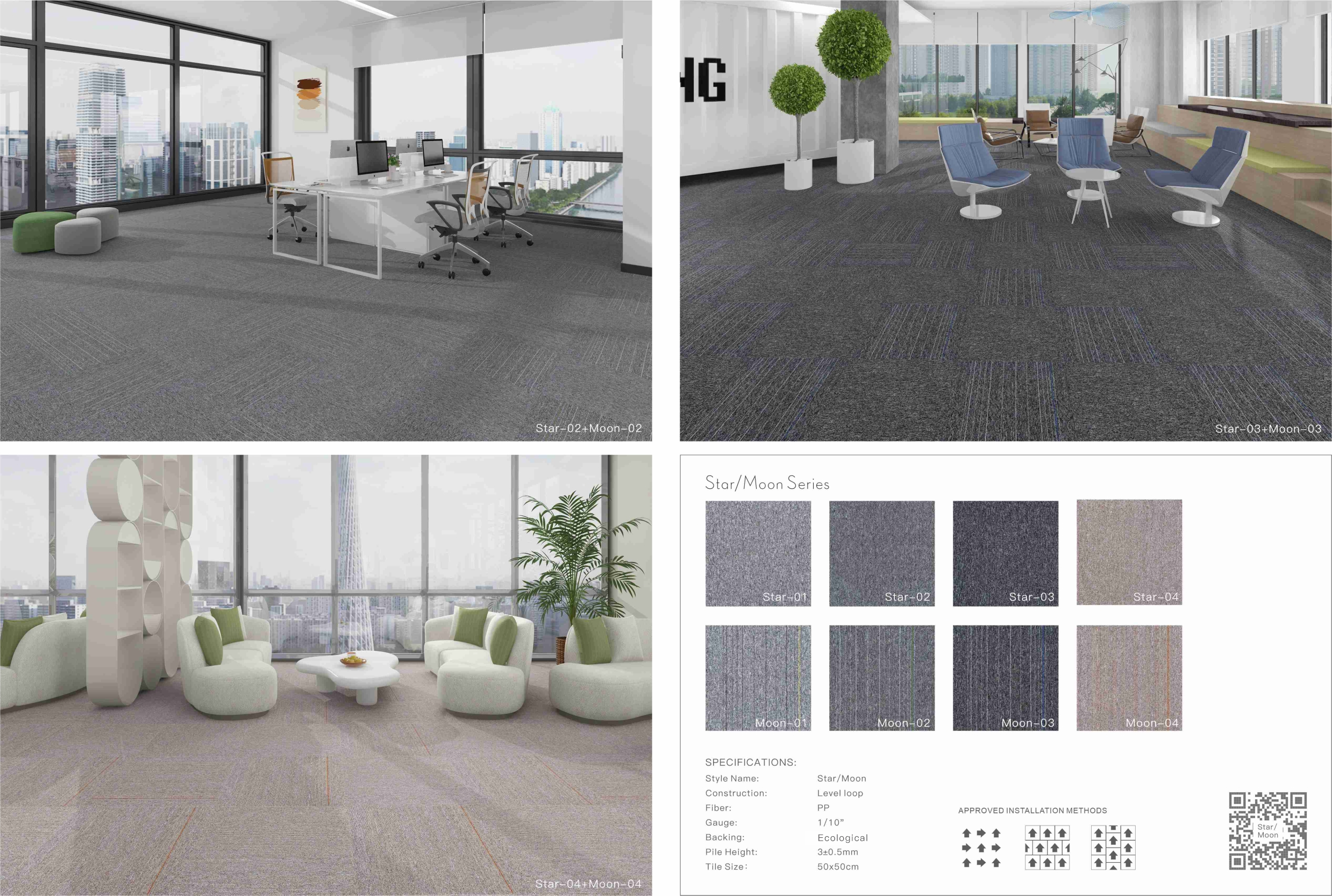
Polypropylene, commonly known as PP, is widely used in commercial carpet products where buyers need to balance material cost, appearance and everyday usability.
For project procurement, this balance can be important. A flooring specification does not always require the highest-cost fiber. The more useful question is whether the selected fiber and construction are appropriate for the intended application.
PP carpet tiles can be considered for projects where the purchasing team is looking for:
A practical commercial flooring material
Consistent appearance across a larger floor area
A modular flooring format
Straightforward product specifications
A solution that can be purchased in project quantities
A reasonable balance between material performance and budget
The final selection should still be based on the traffic level, cleaning conditions, design requirements and project specifications.
This product uses a level loop construction, with the carpet surface formed by loops of relatively consistent height.
Compared with highly decorative carpet surfaces, a level loop structure can provide a more restrained appearance that works well with commercial interior design.
It can be considered for areas where the floor needs to remain visually coordinated with:
Office furniture
Workstations
Meeting rooms
Reception areas
Corridors
Commercial facilities
Public interior spaces
For large projects, a relatively simple carpet surface can also make color planning easier because the flooring does not need to compete with other architectural elements.
The 50×50cm format is one of the most commonly specified modular carpet tile dimensions for commercial flooring.
Each tile covers:
0.25 square meters
For preliminary quantity planning:
Required tiles = Total floor area ÷ 0.25
For example, a 1,000m² project would require approximately:
1,000 ÷ 0.25 = 4,000 tiles
The actual purchasing quantity should include an appropriate allowance for cutting, installation and future maintenance requirements.
For project procurement, it is also useful to keep the final tile calculation consistent with the architectural drawings rather than estimating the quantity only from the total building area.
For office flooring, buyers often need a material that fits the furniture layout and can be coordinated across open workspaces, meeting rooms and circulation areas.
The modular format allows the flooring layout to be planned according to individual rooms or functional zones.
For an office project, buyers may want to confirm:
Total floor area
Tile orientation
Color distribution
Installation method
Expected traffic level
Cleaning requirements
Spare tile requirements
Delivery schedule
These details are usually more important than selecting a carpet only from a product photo.
Commercial buildings can contain several areas with different flooring requirements.
A single project may include offices, corridors, reception areas, meeting rooms and shared spaces. Using carpet tiles gives the project team more flexibility when deciding whether to use one color throughout the building or different colors for different zones.
For contractors and interior designers, this modular approach can also simplify material allocation during installation.
For hospitality projects, appearance is usually a major consideration, but procurement teams also need to think about maintenance and replacement.
Carpet tiles can be useful when individual areas require maintenance at different times.
Before specifying PP carpet tiles for a hotel project, we recommend confirming the expected traffic level, cleaning method, design requirements and any applicable project standards.
For demanding hospitality applications, the fiber, construction and backing should be selected according to the actual project specification rather than assuming that one carpet tile construction is suitable for every area.
A product image alone is not enough for a commercial order.
Before placing a purchase order, buyers should confirm:
Tile size
Fiber type
Gauge
Construction
Pile height
Total thickness
Backing system
Color
Pattern
Packaging
Quantity
Sample approval
This helps prevent specification differences between the sample stage and bulk production.
For project procurement, color and surface appearance are difficult to judge accurately from digital images.
A physical sample allows the buyer, architect or contractor to check:
Actual color
Surface texture
Pile appearance
Thickness
Edge quality
Overall visual effect
Compatibility with other interior materials
For projects with several colors, approving a physical sample or color standard before production can help reduce unnecessary disputes later.
One advantage of modular flooring is that maintenance can be planned together with the original purchase.
For example, if certain areas are expected to receive heavier use, the project owner may choose to retain some matching tiles for future maintenance.
This is particularly useful for commercial properties that are expected to remain operational for many years.
The spare quantity should be determined according to the project environment and the buyer's maintenance strategy rather than using one fixed percentage for every project.
Carpet tiles are modular products, but a professional result still depends on proper site preparation and installation.
Before installation, the contractor should check that the subfloor is:
Clean
Dry
Flat
Free from loose debris
Suitable for the selected installation system
The installation team should also follow the recommended installation method for the specific backing system.
For large commercial projects, it is important to establish the installation direction before work begins. This is especially relevant when the selected design has a directional pattern or when several colors are being combined.
A clear installation plan can help avoid unnecessary tile movement, visual inconsistencies and material waste.
One reason project buyers consider carpet tiles is the ability to manage flooring in sections.
If a localized area becomes heavily worn or damaged, the maintenance team may be able to replace the affected tile instead of removing a much larger carpet area.
This does not mean that every damaged tile can always be replaced without preparation. The replacement tile should match the original specification, color and construction as closely as possible.
For this reason, keeping spare material from the original project can be useful.
Regular vacuuming and cleaning should also follow the maintenance recommendations for the specific carpet fiber and backing system.
The decision between carpet tiles and broadloom carpet depends on the project.
| Project Consideration | PP Carpet Tiles | Broadloom Carpet |
| Modular replacement | More convenient | Usually requires larger-area replacement |
| Quantity planning | Based on individual modules | Based on roll dimensions |
| Design flexibility | Easy to combine tile layouts | Continuous surface appearance |
| Localized maintenance | Practical for individual sections | More difficult |
| Installation planning | Requires tile alignment | Requires roll cutting and seam planning |
| Storage of spare material | Relatively convenient | Requires larger roll storage |
| Large open areas | Suitable depending on design | Can provide a continuous carpet appearance |
For B2B buyers, the better choice is not necessarily the cheapest material. The decision should consider installation cost, maintenance strategy, expected replacement requirements and the operating conditions of the building.
Before requesting a quotation for PP carpet tiles, project buyers can prepare the following information:
Project type
Total floor area
Required tile size
Preferred fiber
Construction
Pile height
Backing requirement
Color or design
Estimated quantity
Floor condition
Expected traffic level
Cleaning method
Installation method
Fire or building-code requirements
Environmental requirements
Any architect or consultant specifications
Required quantity
Sample approval date
Target production date
Required delivery date
Packaging requirements
Shipping destination
Required trade term
Spare tile requirement
Providing this information at the quotation stage allows the manufacturer to recommend a more appropriate specification instead of offering a generic carpet tile.
PP carpet tiles are modular carpet flooring products made with polypropylene fiber. They are supplied as individual carpet modules rather than large rolls and can be used for various commercial and project applications.
The specification shown for this product is 50×50cm.
Each tile covers approximately 0.25m².
This product uses a level loop construction with a 1/10" gauge and approximately 3mm pile height.
They can be considered for commercial applications where polypropylene fiber and the specified carpet construction meet the project's performance requirements.
The final suitability should be assessed according to traffic level, maintenance conditions, building requirements and the complete backing system.
Color customization can be discussed for project orders. The final available options depend on the production specification and order requirements.
Yes. A physical sample is recommended for project buyers because it allows the buyer and design team to check the actual color, texture and construction before approving bulk production.
For 50×50cm tiles, one tile covers 0.25m².
The preliminary calculation is:
Total floor area ÷ 0.25 = approximate number of tiles
Additional material may be required depending on the project layout, cutting requirements and maintenance plan.
One benefit of a modular carpet system is that individual tiles can generally be removed and replaced. For the best visual match, keeping spare tiles from the original production is recommended.
PP carpet tiles can be used in commercial environments, but suitability should not be determined by fiber type alone. Traffic level, construction, pile design, backing, installation quality and maintenance conditions all affect actual service performance.
For heavy-use projects, buyers should provide the expected application and traffic conditions before selecting the final specification.
For small areas, installation can be relatively straightforward. For large commercial or engineering projects, professional installation is recommended because subfloor preparation, tile alignment, installation direction and edge finishing can affect the final result.
For an accurate quotation, buyers should provide:
Project location
Approximate floor area
Required quantity
Preferred tile size
Color or design
Required backing
Delivery deadline
Installation requirements
Any technical specification or tender document
If available, drawings, BOQ documents or reference samples can also help the supplier understand the project more accurately.


