

Views: 0 Author: Site Editor Publish Time: 2026-08-18 Origin: Site


When choosing Office Carpet Tiles for a commercial workspace, buyers often compare low-pile carpet with multi-level loop carpet as if they were two completely separate categories. In reality, the terms describe different aspects of carpet construction. “Low-pile” refers mainly to the height of the carpet surface, while “multi-level loop” describes a loop construction in which the surface contains loops at different heights. A multi-level loop carpet tile can also have a relatively low overall pile height.
This distinction matters because daily wear depends on more than pile height alone. Fiber type, loop structure, density, backing, tile thickness, chair movement, cleaning methods, and installation quality all affect how carpet tiles perform in an office. Low-pile office carpet tiles are often associated with easier movement and routine maintenance, while multi-level loop office carpet tiles provide more surface texture and design depth. Neither option is automatically better for every office.
The right decision depends on where the tiles will be installed, how the space is used, how often furniture moves, and which balance of maintenance, comfort, acoustic performance, and design flexibility matters most.
Low-pile describes carpet height, while multi-level loop describes the variation in loop height and surface construction.
Low-pile carpet tiles are often easier to clean and more convenient for rolling chairs, carts, and frequent movement.
Multi-level loop carpet tiles provide more surface texture and design depth, which can be useful in offices that need a less uniform visual appearance.
Daily wear depends on fiber, construction, backing, density, installation, maintenance, and traffic—not pile height alone.
Low-pile tiles may be more suitable for corridors, high-use workstations, and areas with frequent chair movement.
Multi-level loop tiles may be suitable for meeting rooms, collaborative areas, reception spaces, and offices where visual texture is important.
Nylon, PP, and PET products can behave differently even when they use a similar pile structure.
Buyers should evaluate product samples, chair movement, cleaning procedures, backing, subfloor condition, and replacement requirements before making a decision.
The first step is to understand that the two terms are not exact opposites.
Low-pile carpet has a short surface that sits relatively close to the backing. The surface may be made from cut fibers, level loops, or another compact construction.
Because the pile is short, low-pile carpet generally provides:
A firmer surface underfoot
Easier movement for office chairs and carts
Less space for dirt to settle deeply
A more structured visual appearance
Simpler access for routine vacuuming
Reduced risk of visible flattening compared with taller surfaces
However, “low-pile” does not automatically mean that the product is suitable for heavy commercial traffic. Fiber quality, density, backing, and construction still need to be evaluated.
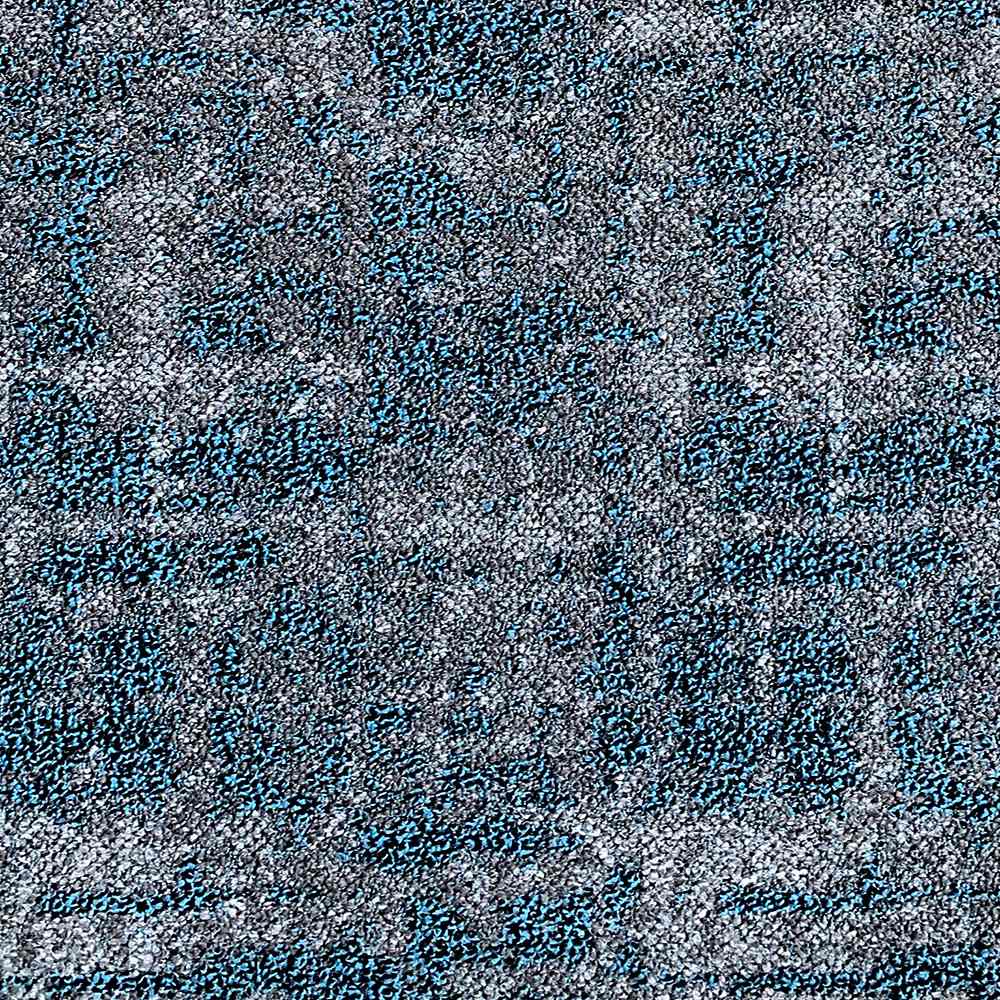
Multi-level loop carpet uses loops at different heights. The variation creates a textured surface that may appear sculpted, patterned, linear, or three-dimensional.
The main characteristics of multi-level loop construction include:
Different loop heights across the surface
More visible texture
Greater design depth
The ability to create patterns without using multiple colors
Potentially better visual concealment of minor marks
A more distinctive appearance than a uniform level loop
The surface may look more complex, but complexity does not automatically mean poor durability. A well-constructed multi-level loop carpet tile can be suitable for commercial spaces. The key is to assess the complete product specification and its intended application.
A low-pile office carpet tile may use a level loop construction, while a multi-level loop tile may also have a relatively short pile. This means a buyer may need to compare two questions separately:
How high is the surface?
How is the surface constructed?
For example, a 50 × 50 cm PP carpet tile with multi-level loops may have a total thickness that remains practical for office use, while a low-pile nylon tile may offer a flatter and more uniform surface. The construction, fiber, and backing will determine how each behaves in daily use.
Daily wear in an office does not come from foot traffic alone. Different parts of the floor are exposed to different types of stress.
Type of wear | Typical office source | What to evaluate |
|---|---|---|
Foot traffic | Corridors, entrances, shared spaces | Fiber resilience, surface density, pattern |
Rolling movement | Office chairs, carts, mobile storage | Pile height, backing, seams, chair compatibility |
Compression | Desks, cabinets, conference tables | Recovery, furniture loads, tile stability |
Soiling | Shoes, food, coffee, dust | Surface texture, color, cleaning procedure |
Spills | Pantry areas, meeting rooms, workstations | Spot-cleaning instructions and replacement access |
Repeated cleaning | High-use commercial zones | Fiber, backing, moisture tolerance, maintenance method |
Layout changes | Furniture relocation and renovations | Modular format, spare tiles, installation system |
A product can perform well against one type of wear and be less suitable for another. For example, a tile may resist foot traffic but be difficult to move across with chair casters. Another may be easy to clean but show marks because of its plain, uniform color.
This is why the best comparison should be based on the actual use pattern of the office rather than a general statement such as “low-pile is more durable” or “multi-level loop is better for commercial spaces.”
Low-Pile Office Carpet Tiles are often selected for practical areas where movement and maintenance are major concerns.
A short surface usually gives office chairs and wheeled equipment a more consistent path. This can be useful in open workstations, corridors, printing areas, and spaces where employees move frequently between desks.
Low-pile carpet also tends to be easier to vacuum because the cleaning head does not need to work through a deep surface. Dust and loose debris generally remain closer to the top, although actual cleaning performance depends on the fiber, density, and vacuum equipment.
Other potential advantages include:
A clean and structured visual effect
Easier placement of furniture
Lower risk of deep indentation from everyday movement
Compatibility with many commercial chair and caster arrangements
Easier access for routine maintenance
Less visual variation across large floor areas
A low-pile surface may also be useful where doors, floor boxes, raised-access panels, and transition strips require careful clearance.
Low-pile does not mean maintenance-free. A short surface can still show dirt, wear paths, stains, or discoloration if the product is installed in a high-use area without an appropriate cleaning plan.
Very uniform low-pile surfaces may also make marks more visible than a textured design. In a busy corridor, a plain color may reveal traffic paths more clearly than a heathered or multi-level pattern.
Low-pile tiles may provide less softness underfoot than taller or more textured carpet constructions. If comfort and visual depth are important in a meeting room or executive office, buyers may prefer a product with more surface variation.
The actual limitations depend on the fiber and construction. A low-pile nylon tile with a suitable backing may offer a different experience from a low-pile PP tile intended for moderate-use areas.
Multi-Level Loop Office Carpet Tiles create surface variation by combining loops at different heights. This can produce a more textured look without requiring a complicated printed pattern.
The surface variation can make the floor appear more dynamic and less repetitive. This is useful in large offices where a completely flat or plain surface may look too uniform.
Multi-level loop construction can also support visual zoning. A textured tile may be used in a meeting area, while a more regular tile from the same collection is used in workstations or corridors.
Potential advantages include:
More visible texture and design depth
Better visual concealment of minor marks in some patterns
Greater design flexibility
Suitable appearance for meeting and collaboration areas
Ability to create patterns through loop height
A more distinctive alternative to plain level loop surfaces
EO Technology describes multi-level loop as a construction with varying loop heights that creates a sculpted surface and adds visual interest to commercial carpet tiles. The practical result still depends on the exact fiber, density, backing, and product design.
A more textured surface may require greater attention during cleaning. Depending on the loop height and density, dirt can settle between surface variations more easily than on a very flat product.
Furniture and chair movement should also be evaluated with a physical sample. A multi-level loop tile may work well with ordinary office chairs, but the actual experience can vary according to pile height, loop density, caster type, backing, and installation quality.
The surface may also create more visual variation between tiles if the installation direction is not controlled. For patterned or directional products, the installer should follow the manufacturer’s layout instructions.
A multi-level loop tile should not be rejected simply because it is textured. Instead, buyers should confirm:
The actual pile profile
The loop construction
The product’s intended commercial application
Cleaning recommendations
Chair and caster compatibility
Installation direction
Replacement requirements
The following table provides a practical comparison for office buyers.
Evaluation factor | Low-pile office carpet tiles | Multi-level loop office carpet tiles |
|---|---|---|
Surface appearance | Flat, clean, and structured | Textured, patterned, and more dimensional |
Chair movement | Usually easier to move across | Depends on loop height and backing |
Routine vacuuming | Generally straightforward | May require attention to surface texture |
Visual concealment | Plain surfaces may show marks | Texture may disguise minor marks more effectively |
Traffic suitability | Often suitable for busy areas when properly specified | Suitable when construction and fiber match the traffic |
Acoustic contribution | Depends on backing and total construction | Surface texture may contribute, but must be tested as a system |
Design flexibility | Often relies on color and tile direction | Can create visual depth through loop variation |
Furniture interaction | Lower surface profile may simplify movement | Sample testing is useful around chairs and tables |
Replacement | Depends on tile format and installation | Direction and pattern matching may require more care |
Best selection logic | Prioritize movement, cleaning, and high-use areas | Prioritize texture, zoning, and visual differentiation |
This comparison should be used as a starting point rather than a universal ranking. A high-quality multi-level loop tile may be more suitable than a basic low-pile tile in one office, while the opposite may be true in another.
Pile construction is only one part of an Office Carpet Tiles specification. Fiber and backing can influence wear, appearance, maintenance, and installation stability.
Nylon is often considered for demanding commercial areas because of its resilience and recovery from compression. PP may be selected for projects where cost and design flexibility are important. PET can be considered when the project has specific design or recycled-content objectives.
Do not assume that all products made from the same fiber will perform identically. The following factors should also be reviewed:
Fiber thickness
Fiber density
Tufting method
Loop structure
Color and pattern
Total carpet weight
Pile height
Backing structure
Maintenance requirements
The Nylon-PVC carpet tile range supplied by LKHY can be reviewed when comparing nylon products for offices and other commercial spaces.
Backing supports the carpet tile and affects how it sits on the subfloor. Common options may include PVC, bitumen, PU, PE, or composite structures.
When comparing low-pile and multi-level loop tiles, check whether the backing is:
Stable under repeated movement
Compatible with the installation method
Suitable for the subfloor
Appropriate for the expected moisture conditions
Easy to remove during replacement
Compatible with the selected adhesive

The better construction often depends on the zone.
Office area | Generally useful priority | Possible direction |
|---|---|---|
Main corridor | Movement, cleaning, concentrated traffic | Low-pile or compact loop construction |
Open workstations | Chair movement, daily wear, appearance retention | Low-pile or compact multi-level loop after sample testing |
Meeting room | Visual quality, chair movement, acoustic comfort | Multi-level loop or textured low-pile construction |
Reception area | Design, branding, visitor traffic | Multi-level loop, custom pattern, or coordinated tile layout |
Quiet room | Comfort, visual calm, sound management | Textured or acoustic-oriented construction |
Printing area | Foot traffic, equipment movement, maintenance | Low-pile and easy-clean construction |
Collaboration zone | Design flexibility and flexible furniture | Multi-level loop or mixed Carpet Tiles |
Executive office | Appearance and comfort | Textured or premium low-pile construction |
Low-pile construction is often practical in corridors because it supports frequent movement and routine cleaning. However, color and pattern are equally important. A highly uniform surface may show soil paths more clearly than a subtle textured design.
Open workstations combine foot traffic with chair movement. Buyers should test the tile with the actual chair casters or a comparable model. The tile should remain stable and should not create excessive resistance during normal movement.
A compact multi-level loop tile may work well if its surface is sufficiently controlled and the backing is stable. The decision should be based on a sample rather than appearance alone.
Meeting rooms provide more room for design variation. Multi-level loop construction may create a more refined and textured appearance, especially when the room uses neutral furniture and acoustic wall or ceiling finishes.
However, meeting rooms often have mobile chairs and tables. A visually attractive tile should still be checked for movement, seams, cleaning, and replacement.
Reception areas need a balance between design and practical maintenance. Multi-level loop tiles can create depth and help establish a distinct visual identity. A custom layout may combine several colors or use a plank arrangement to guide visitors toward the reception desk.
Chair movement is one of the clearest differences between residential and office flooring requirements. Office chairs repeatedly move across a small area, creating concentrated friction and compression.
Before choosing between low-pile and multi-level loop tiles, check:
Chair caster type
Frequency of movement
Whether chair mats will be used
Desk height and clearance
Tile stability
Seam alignment
Backing rigidity
Subfloor levelness
Maintenance around workstations
Low-pile surfaces may provide easier movement, particularly for chairs with smaller or harder casters. Multi-level loop surfaces can still work, but the product should be tested with the intended furniture.
The floor should be level and properly prepared. Loose tiles, raised edges, gaps, or uneven adhesive application may become more noticeable when chairs repeatedly cross the surface.
For heavy furniture and storage units, consider whether the load will remain fixed or move regularly. Fixed furniture may create compression marks, while mobile storage can produce repeated rolling wear.
The cleaning process should be considered during product selection, not after installation.
Low-pile tiles are generally easier to vacuum because the surface is closer to the backing. They may also be easier to inspect for stains and localized damage.
However, a flat or plain design can make marks more visible. Regular vacuuming and rapid spill treatment remain important in high-use areas.
Multi-level loop tiles may require more careful vacuuming because the surface contains different loop heights. The cleaning equipment should be suitable for the construction and should not pull or damage the loops.
The advantages of a textured design include better visual variation and the potential to disguise minor marks. The trade-off is that cleaning procedures should be followed consistently.
For both constructions, the maintenance plan should include:
Routine vacuuming
Entrance matting
Prompt spill treatment
Approved cleaning chemicals
Periodic deep cleaning
Inspection for loose tiles
Spare tile storage
Replacement records
Avoid claiming that a product is completely stain-proof or maintenance-free unless the supplier provides specific test documentation.
The installation method affects how well both low-pile and multi-level loop tiles perform.
Before installation, inspect the subfloor for:
Moisture
Dust
Cracks
Unevenness
Old adhesive
Loose areas
Contamination
Raised-access panel movement
A poorly prepared subfloor can cause visible gaps, shifting, curling, or uneven tile alignment.
For multi-level loop products, the installer should pay particular attention to:
Tile direction
Pattern repeat
Color batch
Surface orientation
Seam alignment
Transition details
For low-pile products, the installer should focus on:
Flatness
Accurate alignment
Seam consistency
Door clearance
Furniture interfaces
Adhesive distribution
Always install a sample area before completing a large project. Review the result under the actual lighting and with representative office furniture.
When future replacement is important, purchase additional tiles from the same production batch. This is especially useful for textured or custom designs where color and pattern matching may be difficult later.
Use the following sequence when choosing between low-pile and multi-level loop office carpet tiles.
The area has frequent chair or cart movement.
Cleaning speed is a major concern.
The office has concentrated corridor traffic.
A flat, structured visual effect is preferred.
Doors, floor boxes, or transitions require a lower surface profile.
The project prioritizes straightforward maintenance.
The office needs more visual texture.
The designer wants to create zones through surface variation.
Meeting rooms or reception areas need a more distinctive appearance.
Minor marks should be less visually obvious.
The project uses coordinated colors and patterns.
The product sample shows acceptable movement and cleaning behavior.
Different office areas have substantially different traffic levels.
Corridors require practical low-pile construction.
Meeting rooms need more texture and design depth.
The project wants one coordinated collection with several surface options.
Maintenance and design priorities vary between zones.
A hybrid approach does not necessarily mean using completely different products. It may involve using different colors, installation directions, or constructions from a compatible product range.
Before finalizing the purchase, ask for:
Face fiber and fiber composition
Construction type
Pile height or surface profile
Total thickness
Tile size
Backing material
Installation method
Recommended adhesive
Chair and caster compatibility
Cleaning instructions
Available test reports
Sample tiles
Color and batch information
Replacement availability
Recommended spare quantity
Packaging and storage requirements
If the project requires custom colors, patterns, or sizes, confirm the approval process before production. LKHY provides a custom carpet tile service for projects that require customized design or product specifications.
The better option between Low-Pile Office Carpet Tiles and Multi-Level Loop Office Carpet Tiles depends on the daily demands of the space.
Low-pile construction is often a practical starting point for corridors, open workstations, printing areas, and other zones where chair movement, cleaning, and frequent traffic are major concerns. Multi-level loop construction may be more suitable for meeting rooms, reception areas, collaboration zones, and projects that require additional visual texture.
The comparison should not be based on pile height alone. Fiber, loop structure, backing, density, tile format, installation quality, chair casters, cleaning procedures, and replacement planning all influence long-term performance.
For commercial buyers, the most reliable approach is to compare physical samples, test representative furniture movement, review complete technical specifications, and evaluate each office zone separately. The right Carpet Tiles are the ones that balance daily wear, maintenance, appearance, and future flexibility for the actual project.
Low-pile tiles are often considered for high-traffic areas because their shorter surface can support easier movement and routine cleaning. However, durability also depends on the fiber, density, backing, installation, and maintenance plan.
They can be suitable, but buyers should test the product with the intended chair casters. Loop height, backing, subfloor condition, installation quality, and chair design all influence how easily the chair moves across the tile.
Not necessarily. Multi-level loop describes the variation in loop height, not a guaranteed durability level. A well-constructed multi-level loop tile can perform well in commercial spaces, but the complete product specification must be reviewed.
Low-pile carpet tiles are generally easier to vacuum because the surface is shorter and more accessible. Multi-level loop tiles can also be maintained effectively when the cleaning equipment and procedure are suitable for the surface construction.
They may contribute to a softer acoustic environment, but acoustic performance depends on the complete tile construction, backing, underlay, subfloor, ceiling, walls, furniture, and room design. Request test information if the project has formal acoustic requirements.
They may feel firmer than taller or more textured carpet constructions. However, comfort also depends on the backing, underlay, total thickness, and the design of the floor system.
Yes. A project may use low-pile tiles in corridors and workstations while using multi-level loop tiles in meeting rooms, reception areas, or collaboration zones. The colors and patterns should be coordinated to maintain visual continuity.
There is no universal answer. PP, PET, and nylon can all be used in different commercial carpet tile constructions. Compare the fiber with the loop structure, backing, traffic level, maintenance plan, and required appearance retention.
Yes. Keeping spare tiles from the original production batch can make future repairs easier and reduce problems caused by color, pattern, or batch differences. Store them in a clean and protected location according to the supplier’s recommendations.


