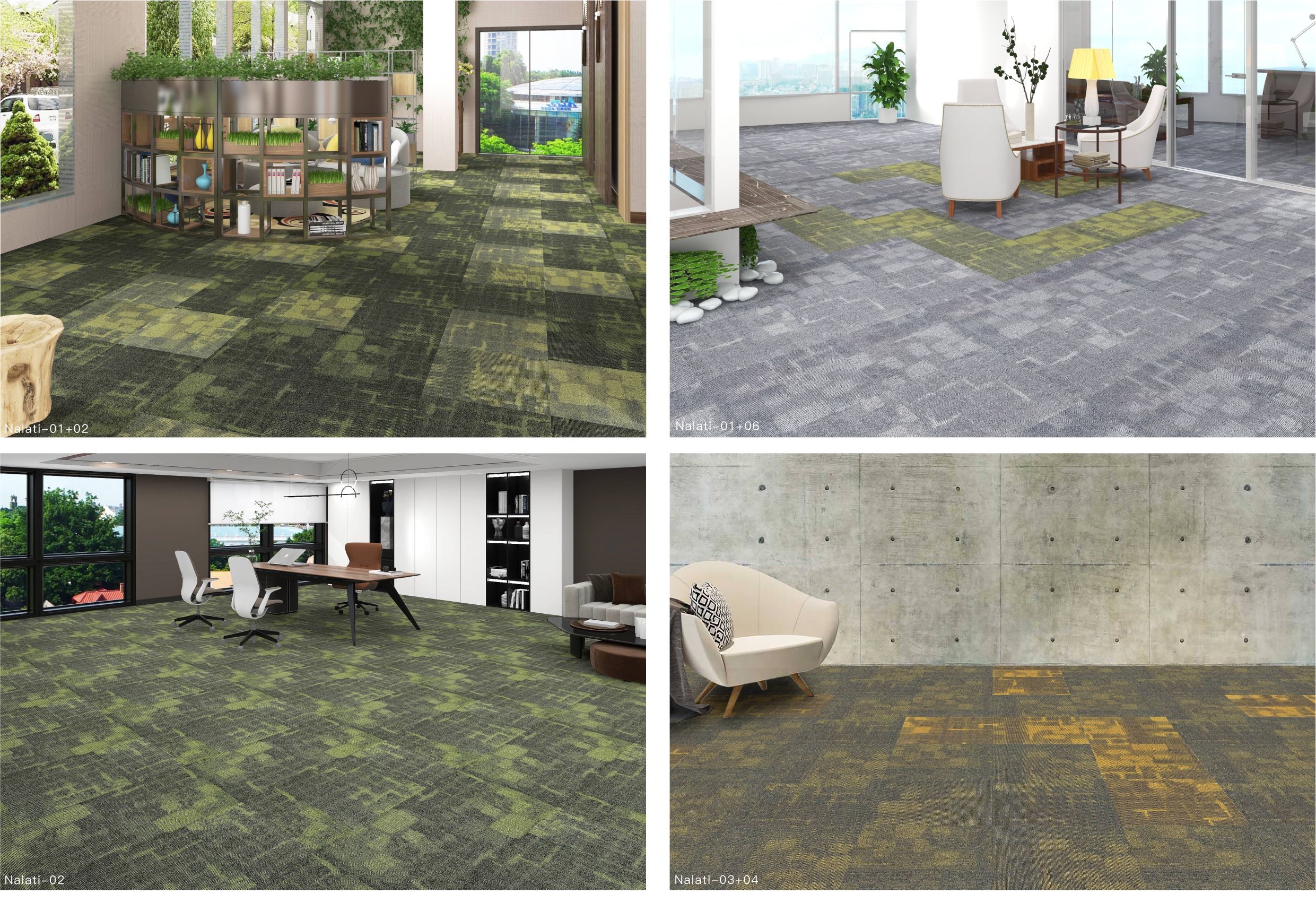
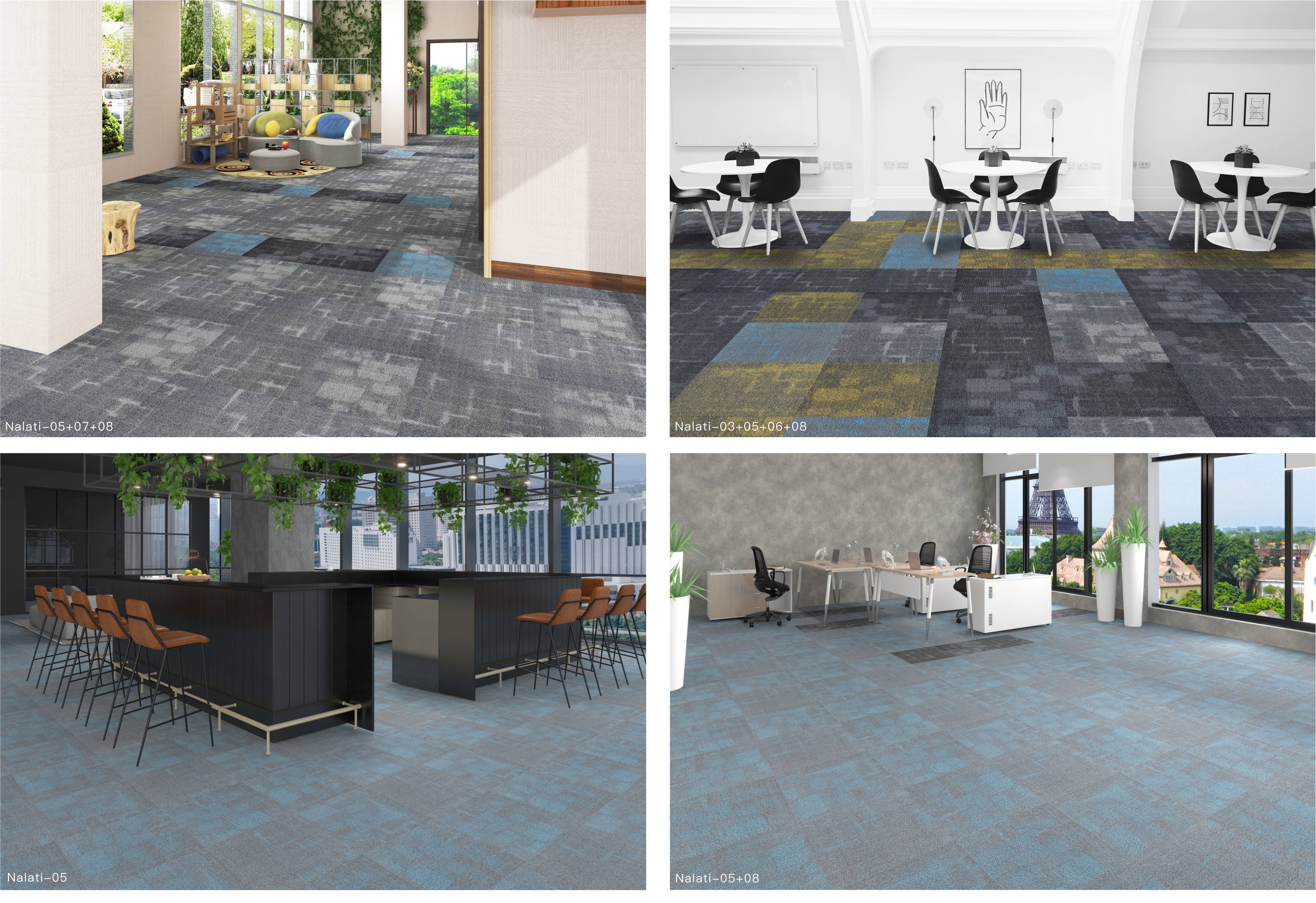
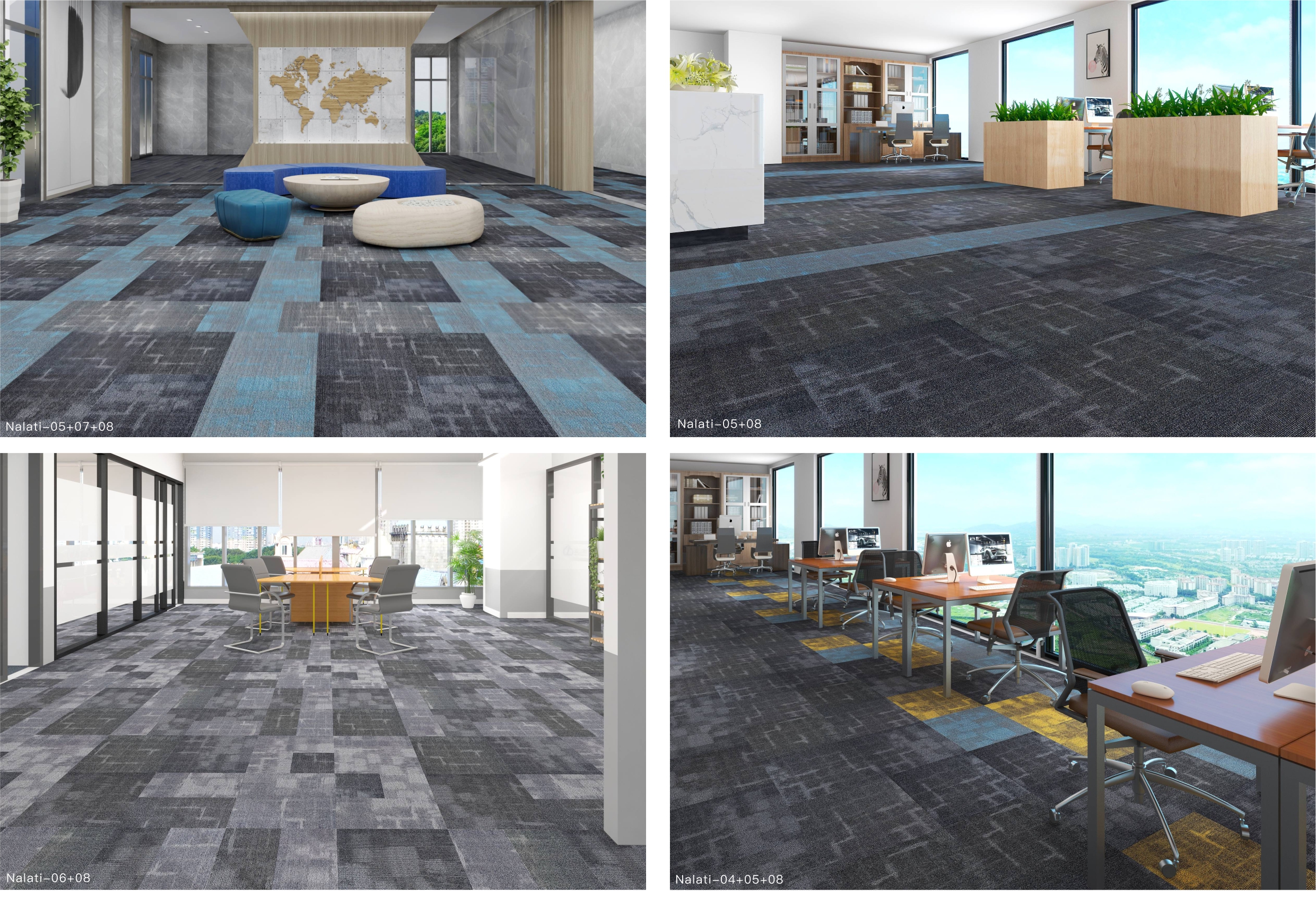
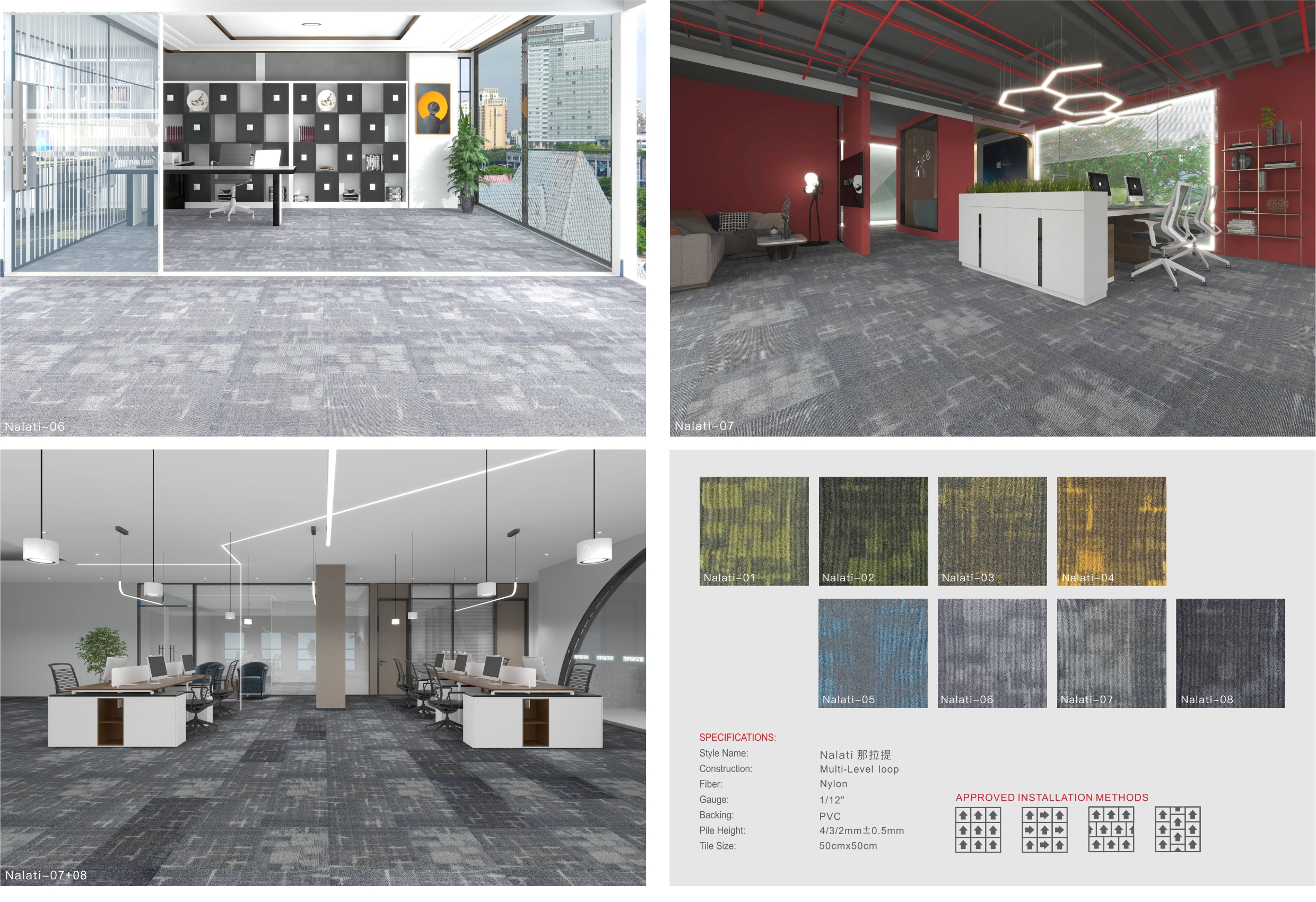
Nalati
LKHY
Nylon Carpet Tiles for Commercial Projects
Nylon Carpet Tiles are widely considered for commercial flooring because nylon offers a good balance of resilience, surface recovery, appearance retention, and design flexibility. Combined with a modular tile format, nylon carpet can provide project buyers with a flooring system that is easier to plan, install in phases, and manage during future repairs.
This product is available in a 50×50cm modular format, with nylon face fiber, multi-level loop construction, and PVC backing. The standard specification can be adjusted according to the requirements of different commercial flooring projects.
Item | Specification |
|---|---|
Product Type | Nylon Carpet Tiles |
Fiber | Nylon |
Construction | Multi-Level Loop |
Backing | PVC |
Gauge | 1/12" |
Pile Height | 4/3/2 ± 0.5mm |
Total Thickness | 6.5 ± 0.5mm |
Tile Size | 50×50cm |
Application | Commercial and Project Flooring |
Customization | Color, pattern, fiber, backing, OEM & ODM |
The above specification is a reference configuration. Final specifications should be confirmed with the buyer before sampling and bulk production.
For commercial flooring, the face fiber has a direct influence on how the carpet surface responds to daily use.
Nylon is known for its resilience. When carpet is exposed to repeated foot traffic and compression, the ability of the fiber structure to recover is an important consideration. This is one reason nylon is frequently specified for commercial interiors where the floor is expected to remain in service for an extended period.
However, fiber type should not be treated as the only indicator of carpet quality.
A project buyer should evaluate the complete construction, including:
Fiber
Yarn characteristics
Construction
Gauge
Pile height
Pile density
Backing
Tile dimensions
Installation system
Maintenance conditions
The right combination depends on the building rather than on a single specification.
This nylon carpet tile uses a multi-level loop construction.
Instead of creating a completely flat surface, different loop heights produce a more structured visual effect. This gives designers more flexibility when working with larger floor areas and can help create a commercial interior that looks more layered without relying on highly complicated patterns.
For project applications, multi-level loop carpet tiles can be considered when buyers want a surface that balances:
Commercial appearance
Practical daily use
Visual texture
Design flexibility
Consistent modular installation
The final visual effect will also depend on lighting, color selection, installation direction, and surrounding interior materials.
The backing is an important part of a carpet tile specification and should not be overlooked during procurement.
This product uses PVC backing, which forms the structural base of each individual tile.
For B2B buyers, the backing should be evaluated together with the installation method and subfloor conditions. The backing affects how the tile behaves during handling, installation, and use, so the final backing specification should be confirmed before production.
For a large project, buyers should avoid comparing carpet tiles only by face fiber or price per square meter. Two products with the same nylon fiber may have different backing structures and therefore different specifications, weights, thicknesses, and installation requirements.
The 50×50cm format is useful for buyers who need a modular flooring system that can be divided into manageable units.
Each tile covers:
0.25m²
A simple preliminary calculation can therefore be made as:
Total floor area ÷ 0.25 = approximate number of tiles
For example, a 2,000m² project would require approximately 8,000 tiles before allowing for cutting, installation requirements, future spare tiles, and the actual project layout.
The final quantity should always be calculated from architectural drawings or the actual installation area rather than relying only on the total building floor area.
This is particularly important for projects containing:
Irregular rooms
Columns
Curved areas
Service rooms
Different flooring zones
Multiple installation directions
Office flooring is rarely a single-use environment.
An office building may include open workspaces, private offices, meeting rooms, reception areas, corridors, break areas, and circulation zones. Each area can have a different traffic pattern and design requirement.
Nylon carpet tiles can be specified according to these different zones instead of treating the entire building as one identical flooring area.
For example:
A restrained color and structured carpet pattern can provide a consistent background for workstations and office furniture.
Designers may choose a different color or installation direction to distinguish meeting spaces from general work areas.
A more noticeable pattern or color combination can be considered where the flooring contributes to the first impression of the building.
The specification should be selected according to expected foot traffic, cleaning requirements, and project standards.
The final product should always be selected based on the actual conditions of each area.
Hotel projects require a different approach from ordinary office flooring.
A hotel may include guest corridors, meeting rooms, public areas, administrative offices, restaurants, and other spaces with very different operating conditions.
For procurement teams, it is therefore useful to divide the project into flooring zones before selecting the carpet specification.
When considering Nylon Carpet Tiles for hospitality projects, buyers can review:
Expected traffic
Cleaning frequency
Furniture movement
Design requirements
Color consistency
Installation schedule
Replacement strategy
Fire and building-code requirements
Required project documentation
Not every nylon carpet tile should automatically be specified for every hotel area. The final construction should be matched to the application and project requirements.
Nylon carpet tiles can also be considered for selected areas within schools, universities, training centers, and other institutional buildings.
The modular format can be useful when the building is renovated in stages.
For example, a school may renovate one floor during a holiday period and another floor during a later phase. Using a modular carpet system can allow the purchasing team to manage each area separately rather than requiring one continuous installation across the entire building.
For institutional projects, buyers should confirm the applicable:
Fire requirements
Indoor environmental requirements
Cleaning standards
Traffic expectations
Installation conditions
Maintenance procedures
These requirements can vary between countries and building types.
When purchasing commercial carpet tiles, comparing the price per square meter alone can lead to an incomplete decision.
A more useful comparison should include the complete specification.
Comparison Point | What B2B Buyers Should Check |
Fiber | Nylon type and yarn specification |
Construction | Level loop, multi-level loop, or other construction |
Gauge | Machine gauge |
Pile Height | Actual specified pile height |
Backing | PVC, bitumen, PE, PU, or other system |
Total Thickness | Overall product thickness |
Tile Size | 50×50cm or project-specific size |
Color | Standard or customized |
Quantity | Project area and required spare material |
Sample | Physical sample approval |
Production | Lead time and production capacity |
Packaging | Carton / pallet requirements |
Delivery | Required delivery schedule and destination |
This type of comparison gives procurement teams a clearer picture of what they are actually buying.
A common purchasing mistake is to assume that a thicker carpet automatically means a better commercial product.
Thickness is only one part of the specification.
A carpet tile should be evaluated according to the relationship between fiber, construction, pile height, backing, density, and intended use.
For example, two products may have similar overall thickness but completely different constructions and performance characteristics.
For project procurement, it is therefore better to request the complete technical specification instead of asking only:
“How thick is the carpet tile?”
A more useful technical request is:
“Please provide the fiber, construction, gauge, pile height, pile weight, backing, total thickness, tile size, and available test documentation.”
This gives the purchasing team a much more reliable basis for comparison.
For B2B projects, a sample should not be treated simply as a sales sample.
It can be used as a reference point for the final production.
Before placing a bulk order, the buyer can use the approved sample to confirm:
Color
Texture
Pattern
Tile size
Edge condition
Surface appearance
Backing
Overall thickness
For projects involving several colors, it is particularly important to establish a clear color reference.
The approved sample should be retained by the project team so that the final goods can be checked against the agreed specification.
Carpet tiles give designers more flexibility because different modules can be combined within the same floor.
A commercial project does not necessarily need to use one color everywhere.
Designers can create a more organized floor by combining:
Main neutral colors
Accent colors
Different tile directions
Simple geometric arrangements
Zone-based color changes
Border effects
Pattern transitions
For B2B buyers, the important point is to finalize the design before bulk production.
If colors or patterns are changed after production begins, the project schedule and material planning may be affected.
For a small order, color matching may seem straightforward.
For a large commercial project, it becomes more important.
A project may be installed across several floors or delivered in multiple shipments. If the buyer expects the same carpet tile to be supplied later, keeping the original product information and color reference is useful.
For repeat orders, buyers should provide:
Original model
Color reference
Approved sample
Original specification
Required quantity
Previous order information where available
This helps the supplier understand that the new order is a continuation of an existing project rather than a completely new product inquiry.
Actual color matching should still be confirmed during sampling and production because visual appearance can be affected by lighting, display screens, and production conditions.
One of the practical considerations of modular carpet is future replacement.
A commercial building may operate for many years. During that period, some areas may experience localized staining, damage, or heavier wear than the rest of the floor.
Keeping spare tiles from the original production can make future maintenance easier.
For project buyers, the spare quantity should be based on:
Total project area
Expected operating period
Traffic distribution
Availability of future production
Importance of maintaining the original appearance
There is no single spare percentage that is appropriate for every project.
For large or phased developments, it is worth discussing the spare material strategy before the initial order is finalized.
Large commercial developments are often completed in stages.
A project may include:
Phase 1 → Main building
Phase 2 → Additional floors
Phase 3 → Renovation or expansion
In this situation, purchasing teams should consider whether future phases will require the same carpet specification.
Before the first production run, it can be useful to record:
Product model
Fiber
Construction
Backing
Gauge
Pile height
Color reference
Tile size
Packaging information
This creates a clearer technical record for future procurement.
For repeat projects, final availability should always be confirmed with the manufacturer before placing the new order.
Carpet tile installation is modular, but the installation process still requires planning.
Before installation begins, the contractor should check the subfloor and confirm that it meets the requirements of the selected installation system.
The installation team should also establish:
Starting point
Tile direction
Layout pattern
Room boundaries
Door openings
Column positions
Edge cuts
Transition areas
For patterned carpet tiles, installation direction becomes especially important because rotating individual tiles can change the appearance of the finished floor.
For large projects, it is recommended to prepare a layout plan before installation rather than allowing the installation direction to be decided room by room.
The maintenance plan should be considered before the carpet is purchased.
Routine care generally begins with regular vacuuming and prompt treatment of localized spills. The exact cleaning method should follow the carpet manufacturer's recommendations and take the selected fiber and backing into account.
For facility managers, it can be useful to divide maintenance areas into:
Main circulation areas
Entrance zones
Work areas
Meeting rooms
Low-traffic spaces
Different areas may require different cleaning frequencies.
If an individual tile cannot be restored through appropriate cleaning, its modular format allows the affected section to be considered for replacement.
For commercial projects, product documentation can be just as important as the physical product.
Before production, buyers may need to confirm which documents are required by the project.
Depending on the destination market and project specification, this may include:
Technical data sheet
Product specification
Sample approval record
Test reports
Certification documents where applicable
Packing information
Inspection records
Commercial invoice
Packing list
Shipping documents
The exact documents required depend on the buyer, destination country, project tender, and applicable standards.
If a project has mandatory certification or testing requirements, buyers should communicate these requirements before quotation and production.
Different commercial projects may require different visual or technical specifications.
For B2B buyers, customization can be discussed around:
Color
Pattern
Tile size
Fiber selection
Construction
Gauge
Pile height
Backing
Packaging
Labeling
OEM production
ODM development
Customization should be confirmed before production because changes to the specification can influence material selection, production planning, minimum quantities, sampling, and delivery time.
For private-label projects, the buyer should also confirm artwork, packaging information, labels, and product identification before mass production.
A project quotation becomes much more accurate when the buyer provides enough information at the beginning.
Instead of sending only:
“Please quote nylon carpet tiles.”
A better inquiry would include:
Project type
Project location
Approximate area
Required tile size
Preferred nylon specification
Color or reference image
Backing requirement
Estimated quantity
Expected delivery date
Installation requirements
Required certifications or testing
Whether the order is standard or customized
If the project has a BOQ, specification sheet, drawing, or tender document, providing the relevant information can help the manufacturer evaluate the requirement more accurately.
Distributors have different concerns from project contractors.
A distributor may need a product that can be supplied repeatedly rather than a one-time customized specification.
For distribution business, buyers may therefore focus on:
Stable product specifications
Repeat-order consistency
Available colors
Packaging
Stock planning
Production capacity
Sample availability
Private-label options
Shipping efficiency
For standard products, maintaining a clear product code and specification record can make repeat purchasing easier.
For customized products, the buyer should retain the approved sample and technical specification for future reference.
Contractors usually have a more practical concern: the flooring needs to arrive in the correct specification and fit the construction schedule.
Before ordering, contractors can confirm:
Installation area
Subfloor condition
Room dimensions
Access conditions
Installation sequence
Tile size
Fiber
Construction
Backing
Color
Pattern
Quantity
Sample approval date
Purchase order date
Production date
Shipping date
Site installation date
The earlier these details are confirmed, the easier it is to coordinate material supply with the construction schedule.
For designers, the carpet tile is part of the overall interior system rather than an isolated flooring product.
The selected tile needs to work with:
Furniture
Wall finishes
Lighting
Ceiling materials
Partitions
Branding
Circulation patterns
Nylon carpet tiles can support different design approaches because the modular format allows designers to combine colors and installation directions.
For large projects, it is useful to review the carpet under actual project lighting rather than relying only on a computer screen or small digital image.
For project orders, buyers should establish the inspection requirements before production is completed.
Depending on the agreed specification, checks may include:
Tile dimensions
Color consistency
Surface appearance
Construction
Backing condition
Thickness
Packaging
Quantity
If a project has a specific inspection standard, it should be agreed before production rather than introduced after the goods have been manufactured.
For customized products, the approved sample and final technical specification should be used as the main reference for production inspection.
Nylon Carpet Tiles are modular carpet flooring products using nylon as the face fiber. They are commonly considered for commercial and institutional interiors where buyers require a combination of resilience, modular installation, and design flexibility.
They can be suitable for many commercial applications, but the final selection should consider the complete product construction, traffic level, maintenance conditions, installation method, and applicable project requirements.
The reference specification for this product is 50×50cm.
Each tile covers approximately 0.25m².
The reference product uses Multi-Level Loop construction.
The final construction should be confirmed on the technical specification before ordering.
The reference specification uses PVC backing. Other backing systems may be discussed depending on the project and product requirements.
Yes. Color and pattern customization can be discussed for project orders. The final color should be confirmed through physical sampling before bulk production.
Different tile formats can be discussed according to production capability and project requirements. Custom size may affect material planning, production setup, quantity, and lead time.
They can be considered for suitable hotel areas, but the final specification should be selected according to the traffic, cleaning, design, fire, and other technical requirements of the specific space.
Yes. They can be considered for open offices, meeting rooms, private offices, reception areas, and other suitable commercial interiors.
The modular format allows individual tiles to be removed and replaced when necessary. Keeping spare tiles from the original project can make future replacement easier.
For commercial projects, physical sample approval is strongly recommended. It allows the buyer and design team to confirm color, texture, construction, backing, and overall appearance before bulk production.
The most useful information includes project area, application, tile size, preferred fiber, construction, backing, color, quantity, destination, delivery schedule, and any required technical or certification documents.
OEM and ODM production can be discussed according to the required product specification, design, packaging, labeling, and order quantity.
For B2B buyers, choosing Nylon Carpet Tiles should begin with the project requirement rather than a product photograph or a single price.
The right specification depends on how the space will be used, how the carpet will be installed, how it will be maintained, and whether the same product may need to be supplied again in the future.
A 50×50cm nylon carpet tile with multi-level loop construction and PVC backing provides one practical configuration for commercial flooring. For projects with different requirements, the specification can be reviewed and adjusted before sampling and production.
For a quotation, buyers can provide the project type, floor area, preferred tile size, color, application, quantity, and delivery location. This gives the manufacturer a clearer basis for recommending the appropriate Nylon Carpet Tiles for the project.
Contact LKHY to request samples, discuss classroom design options, or receive a quotation for your education flooring project.