

| Color: | |
|---|---|
| Size: | |
| Construction: | |
| Material: | |
| Gauge: | |
| Backing: | |
| Total Thickness: | |
| Quantity: | |
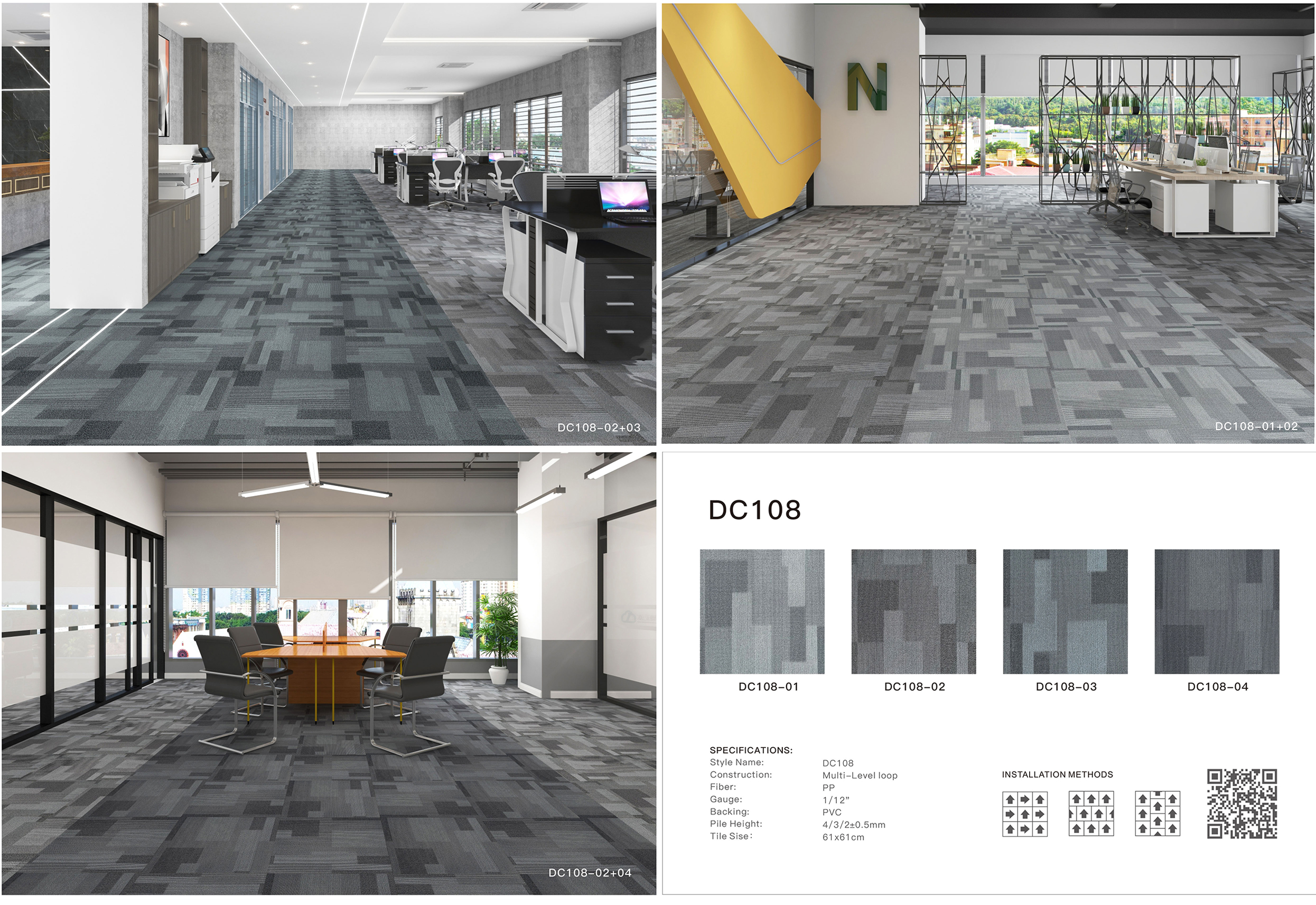
DC108
LKHY


Modern commercial spaces require flooring solutions that balance design flexibility, durability, maintenance efficiency, and project customization. LKHY modular carpet tiles are developed for architects, contractors, distributors, and commercial project buyers who need reliable flooring products for different applications.
Unlike traditional broadloom carpet, modular carpet tiles provide greater flexibility during installation and maintenance. Individual tiles can be replaced when necessary, making them a practical choice for high-use environments such as offices, hotels, retail stores, corporate buildings, and public facilities.
With multiple choices of fiber materials, backing systems, tile sizes, thickness, pile height, and pile weight, these carpet tiles can be customized according to different project requirements, budgets, and performance expectations.
Different commercial environments require different fiber solutions.
Available fiber options include:
| Fiber Material | Suitable Applications |
|---|---|
| Polypropylene (PP) | Cost-effective commercial projects, offices, retail spaces |
| Polyester (PET) | Design-focused projects, decorative commercial areas |
| Nylon | Heavy traffic areas requiring higher wear resistance |
Buyers can select the most suitable fiber based on:
Expected foot traffic
Project budget
Maintenance requirements
Design requirements
Service life expectations
The backing layer plays an important role in carpet tile performance, including dimensional stability, installation experience, and long-term durability.
Available backing options:
Suitable for:
Office buildings
Commercial spaces
Retail environments
Advantages:
Stable structure
Good dimensional performance
Easy installation
Commonly selected for:
Large commercial projects
Heavy-duty applications
Contract flooring projects
Advantages:
Strong stability
Excellent tile weight
Helps maintain flat installation
Suitable for buyers looking for:
Lightweight solutions
Easier transportation
Flexible installation
Often used in projects requiring:
Improved comfort
Better acoustic performance
Premium flooring solutions
Recommended for:
Hospitality projects
Comfortable office environments
Higher-end commercial applications
| Parameter | Options |
|---|---|
| Fiber | PP / Polyester / Nylon |
| Gauge | 1/10", 1/12", 1/8+4, 1/6+6, 5/64" |
| Thickness | 5mm / 6mm / 7mm / 8mm / 9mm / 10mm |
| Pile Weight | 420-620g/m² |
| Tile Size | 50×50cm / 61×61cm / 100×33.3cm / 100×25cm |
Modular carpet tiles are widely used because they allow designers and contractors to create different flooring layouts without being limited by traditional carpet rolls.
Possible installation patterns include:
Monolithic installation
Quarter-turn layout
Ashlar pattern
Brick pattern
Directional design
This flexibility allows commercial spaces to achieve different visual effects while maintaining practical performance.
Polypropylene is one of the most commonly selected materials for commercial carpet applications because of its practical performance.
Key characteristics include:
Low moisture absorption
Good stain resistance
Easy daily cleaning
Stable color appearance
Resistance to common commercial cleaning methods
Because polypropylene fiber does not easily absorb moisture, it is often considered for areas where humidity control and cleaning efficiency are important.
Typical applications include:
Office buildings
Retail stores
Educational facilities
Basement commercial areas
Hospitality spaces
Commercial flooring often needs to maintain its appearance for years.
Polypropylene carpet tiles use solution-dyed fiber technology, where color is added during fiber production rather than only applied to the surface.
This helps improve:
Color retention
Resistance to fading
Appearance stability after cleaning
It is suitable for projects where consistent appearance is important, especially:
Hotels
Chain stores
Corporate offices
Public buildings
The carpet surface provides a softer feeling compared with hard flooring materials.
The fiber structure offers:
Comfortable walking experience
Good resilience
Reduced tendency to flatten under normal use
This makes modular carpet tiles suitable for spaces where people stay for long periods, such as:
Workstations
Meeting rooms
Hotel lounges
Reading areas
For project buyers, initial purchase price is only one consideration.
Modular carpet tiles can help reduce long-term costs through:
Faster installation
Lower transportation difficulty
Easier maintenance
Individual replacement capability
For contractors and facility managers, this can reduce operational interruptions during future repairs.
Suitable for:
Open-plan offices
Executive offices
Meeting rooms
Reception areas
Workspaces
Benefits:
Improve workplace comfort
Reduce walking noise
Provide professional appearance
Hotels often require flooring that combines aesthetics and durability.
Applications:
Guest corridors
Lobby areas
Conference rooms
Business lounges
Advantages:
Easy maintenance
Flexible replacement
Custom design options
Retail stores need flooring that can withstand customer movement while supporting brand image.
Carpet tiles offer:
Multiple design combinations
Quick renovation capability
Comfortable customer experience
Suitable for:
Real estate developments
Corporate headquarters
Exhibition spaces
Public buildings
Training centers
Modular carpet tiles are mainly used for commercial and institutional flooring applications.
Common uses include:
Offices
Hotels
Retail stores
Schools
Airports
Corporate buildings
Public facilities
They are preferred by many project buyers because they are easier to install and maintain compared with traditional carpet rolls.
The main difference is the installation format.
Traditional carpet rolls:
Require large-area installation
Are more difficult to repair locally
Usually generate more waste during cutting
Modular carpet tiles:
Installed piece by piece
Easier to replace damaged areas
Provide more design flexibility
Are easier to transport
For commercial projects, modular carpet tiles often provide better lifecycle value.
Yes.
The suitability depends on:
Fiber selection
Construction type
Backing system
Traffic level
For high-footfall areas, buyers usually consider nylon fiber or heavier construction options.
For standard commercial applications, polypropylene carpet tiles provide a practical balance between performance and cost.
Yes.
We support customized production for different project needs.
Customization includes:
Fiber material
Carpet color
Tile dimensions
Backing type
Thickness
Pile weight
Packaging
This service is suitable for:
Contractors
Architects
Flooring distributors
Hotel groups
Commercial developers
Different markets and projects use different sizes.
Common options include:
Suitable for:
Offices
Schools
Standard commercial applications
Popular in:
North American commercial projects
Large office buildings
Suitable for:
Modern office designs
Creative commercial interiors
Directional patterns
Polypropylene carpet tiles can be considered a practical flooring choice because polypropylene requires relatively low moisture absorption and has good durability.
Longer service life and modular replacement also help reduce unnecessary flooring waste.
For projects with specific environmental certification requirements, buyers can discuss available material options and documentation.
Recommended maintenance includes:
Regular vacuum cleaning
Remove visible dirt quickly
Use suitable carpet cleaning solutions
Treat stains as early as possible
Professional cleaning according to traffic conditions
Proper maintenance helps preserve appearance and extend product life.
Yes.
Stock samples can be provided for evaluation.
For customized designs, sample production may involve additional costs depending on:
Material selection
Design complexity
Production requirements
Common payment methods include:
T/T
L/C
PayPal
Other payment methods can be discussed depending on order requirements.
To recommend the right carpet tile solution, buyers should provide:
Project type
Installation location
Required quantity
Preferred size
Fiber preference
Backing requirements
Delivery destination
Expected schedule
This helps suppliers provide a more accurate quotation and technical recommendation.


