Vienna
LKHY
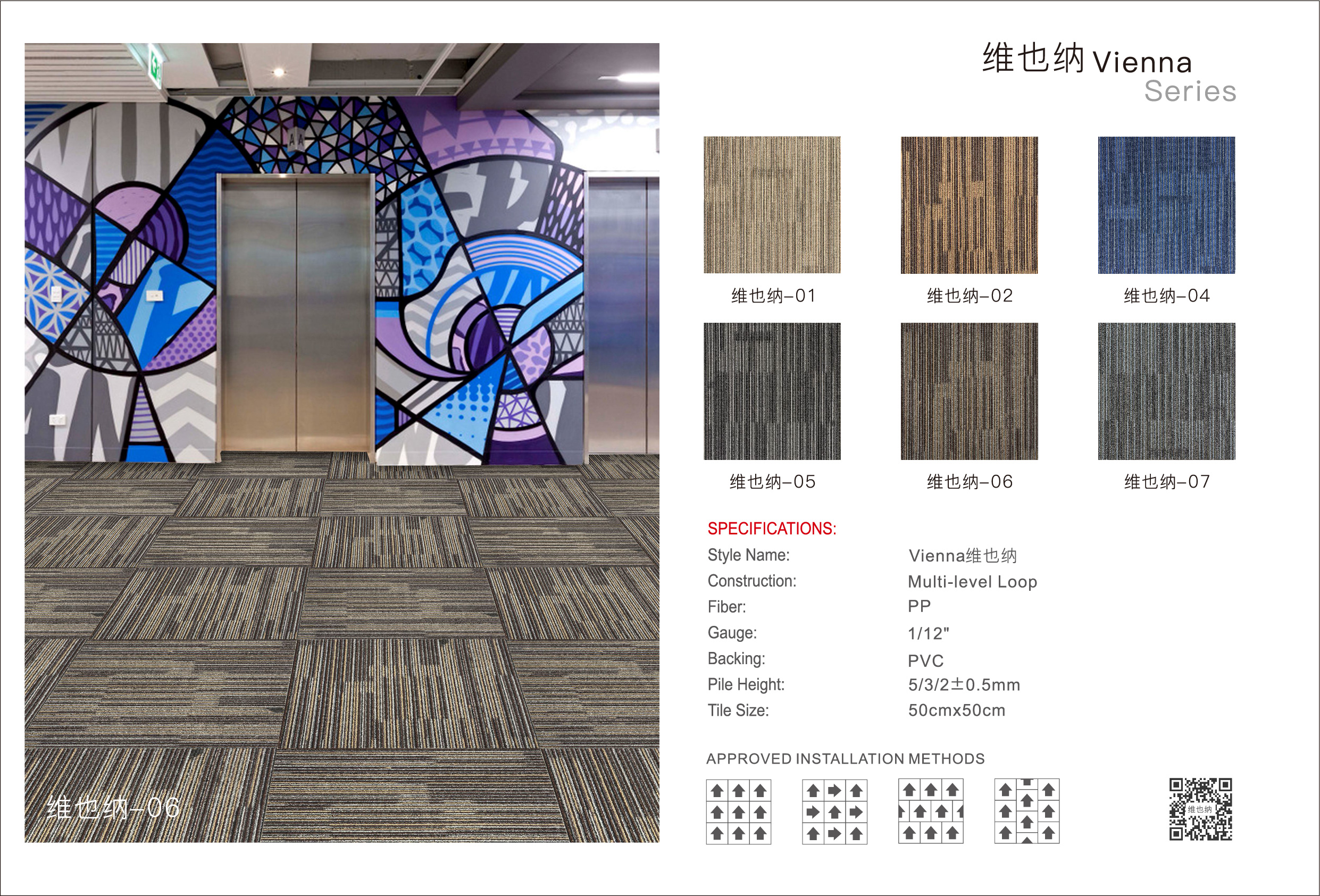
The Vienna series is a 50 × 50 cm Jacquard PP PVC carpet tile made with PP fiber, multi-level loop construction and a PVC backing.
What makes this carpet tile different is mainly the surface.
Instead of a completely flat carpet face, the multi-level loop construction creates subtle changes in height and texture. When several tiles are installed together, the jacquard pattern gives the floor a more layered appearance, while the overall look remains quiet enough for commercial interiors.
This makes Vienna a practical option for projects where the carpet needs to do two things at the same time: look considered after installation and remain easy to manage during everyday use.
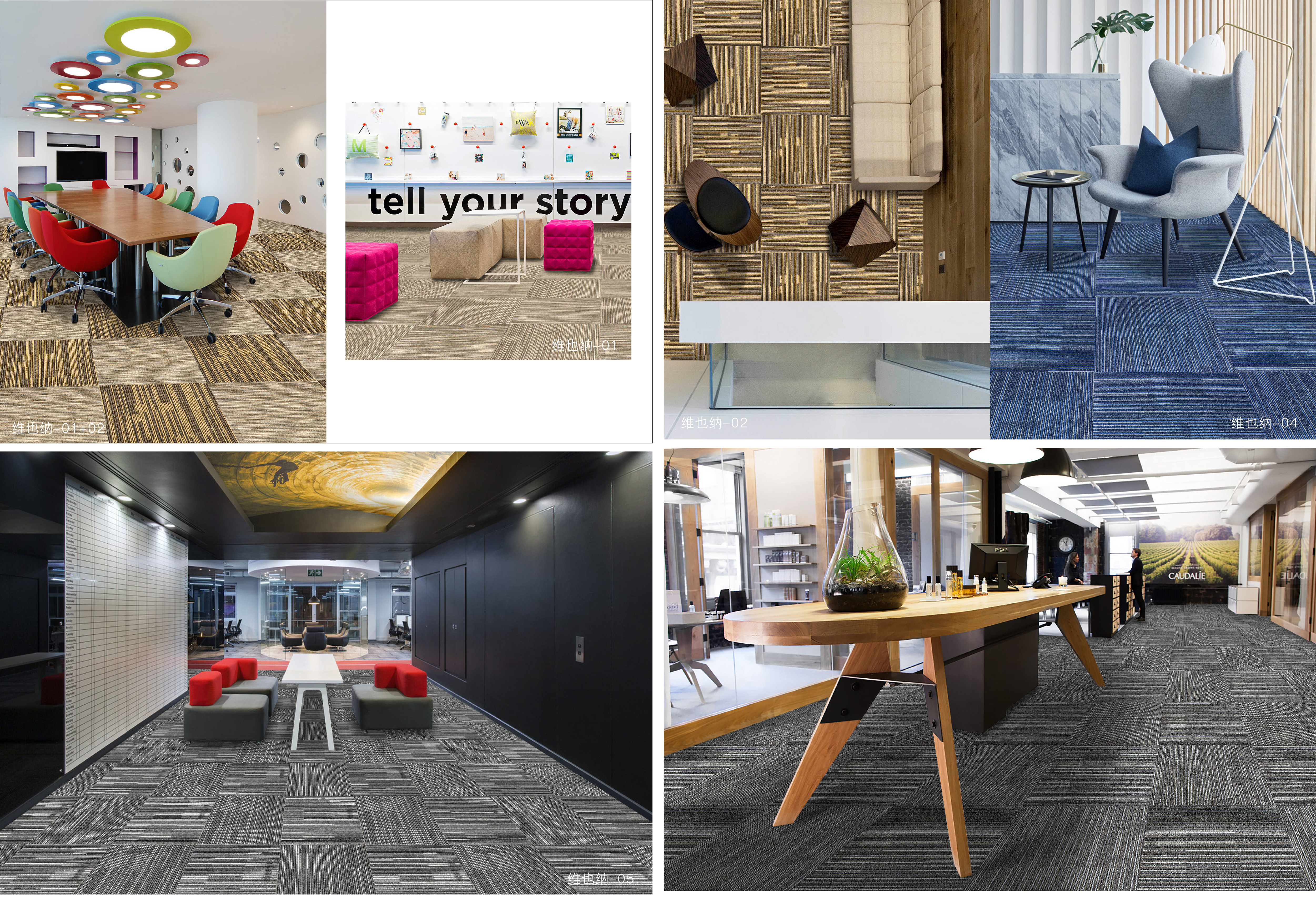
It can be used in cinema lobbies, hotel corridors, offices, meeting rooms, reception areas and other commercial interiors where a modular carpet system makes sense.
The standard tile is 50 × 50 cm, while other sizes and design options can be discussed for projects with different layout requirements.
Item | Specification |
|---|---|
Product Name | Jacquard PP PVC Carpet Tiles |
Series | Vienna |
Construction | Multi-Level Loop |
Face Fiber | Polypropylene (PP) |
Gauge | 1/12" |
Backing | PVC |
Pile Height | 5 / 3 / 2 ± 0.5 mm |
Standard Size | 50 × 50 cm |
Optional Size | 25 × 100 cm / 33.33 × 100 cm |
Application | Cinema, Hotel, Office, Conference Room, Commercial Interior |
Color | Vienna Series Colors / Custom Colors |
Pattern | Jacquard |
Customization | Size, Color, Pattern, Backing and Packaging |
A carpet tile can have all the right specifications on paper and still look ordinary once it is installed.
Vienna takes a slightly different approach.
The multi-level loop surface gives the carpet a combination of higher and lower texture. The jacquard pattern then adds another layer of visual variation without making the floor excessively busy.
From a distance, the floor looks relatively calm.
Up close, the texture becomes more noticeable.
That difference is useful in commercial interiors because the carpet does not need a large graphic pattern to create visual interest. The texture itself does part of the work.
It also gives designers more freedom when choosing where to use the product. It can sit comfortably beneath office furniture, hotel lighting or cinema interiors without competing too strongly with the rest of the space.
The multi-level loop construction is not only about creating a decorative effect.
Different loop heights give the surface a less uniform appearance than a flat carpet. Small differences in texture, light reflection and foot traffic marks are therefore less visually obvious than they might be on a very plain surface.
For everyday commercial use, that can be useful.
Think about a hotel corridor.
People rarely walk exactly along the same path. Some areas receive more traffic than others, especially near elevators, entrances and connecting corridors.
The same happens in an office around reception areas, meeting rooms, printers and shared spaces.
A textured carpet surface gives the floor a little more visual variation, so normal changes caused by daily use are not necessarily as obvious as they would be on a completely uniform surface.
Of course, the right color and pattern still matter. A carpet should always be selected according to the expected traffic and cleaning conditions of the project.
Vienna uses polypropylene (PP) as its face fiber.
PP is often selected for commercial carpet applications where buyers are looking for a practical combination of appearance, routine maintenance and cost control.
For this product, the fiber works together with the multi-level loop construction rather than being treated as a separate feature.
The result is a carpet surface that feels structured rather than overly soft or loose.
This is particularly suitable for spaces where people are walking through the area throughout the day rather than sitting directly on the carpet for long periods.
For example:
Hotel corridors
Cinema entrance areas
Office circulation areas
Reception spaces
Meeting rooms
Commercial lounges
If a project has unusually demanding traffic conditions or a specification requiring a different fiber, PP can also be compared with nylon or other available constructions before the final material is selected.
The backing is easy to overlook because it cannot be seen after installation.
But it has a direct effect on how a carpet tile feels in the hand, behaves during installation and sits on the floor.
Vienna uses a PVC backing as its standard configuration.
The PVC layer gives the 50 × 50 cm tile a defined structure, making it easier to handle as an individual modular piece.
It also gives the tile a relatively firm base compared with a carpet without a structured backing.
For commercial projects, this is useful when hundreds or thousands of individual tiles need to be handled, stored and installed across a larger floor area.
PVC also offers resistance to moisture penetration compared with many textile-only backing constructions. However, this should not be interpreted as making the entire carpet system waterproof. The condition of the subfloor, joints, installation method and surrounding environment still matter.
The standard 50 × 50 cm size is one of the most practical aspects of this product.
It is large enough to cover the floor efficiently but small enough to allow individual sections to be handled without much difficulty.
For installers, the square format makes it easier to establish a regular layout.
For designers, it provides a simple base for changing laying directions or combining colors.
For facility teams, the benefit becomes more obvious later.
If one tile is badly stained or damaged, there is no need to disturb the entire surrounding floor. The affected tile can be removed and replaced with a matching spare.
That is one of the reasons we recommend keeping some tiles from the original production batch after a large project is completed.
A few boxes stored properly can become useful several years later.
Cinema spaces have their own flooring requirements.
The entrance and lobby areas see repeated foot traffic, while food and drink are often present nearby. The floor also needs to fit into a darker interior without making the space feel visually heavy.
The jacquard texture of Vienna works well with this type of environment.
Darker or mixed-color options can also be considered where the project needs a surface that is less visually sensitive to everyday marks.
For areas immediately around food service counters or entrances, the final color and maintenance requirements should be evaluated separately.
Hotel corridors are a good example of where carpet tile construction becomes practical.
A corridor can look almost perfect on the day of opening, but the areas near elevators, room entrances and stair connections usually experience more traffic.
With carpet tiles, maintenance can be focused on individual sections instead of treating the entire corridor as one piece.
Vienna's patterned surface also gives the corridor more visual depth without requiring a large decorative print.
For hotels, the series can be considered for:
Guest corridors
Lift lobbies
Meeting areas
Reception surroundings
Lounge spaces
Selected guest-area interiors
The final selection should depend on the hotel's design concept and expected traffic level.
Office carpet has a difficult design brief.
It needs to look professional enough for visitors, but it also has to work with desks, office chairs, partitions and changing furniture layouts.
A heavily patterned carpet can sometimes compete with the rest of the interior.
A completely plain carpet can look flat across a large floor.
Vienna sits somewhere between the two.
The jacquard pattern provides texture, while the multi-level loop creates small changes across the surface. This gives a large office floor some visual movement without making the carpet the main feature of the room.
It works particularly well with neutral furniture and modern office layouts.
In meeting rooms, flooring is usually selected together with the walls, ceiling, lighting and furniture.
Vienna can provide a softer visual transition than a hard floor while keeping the overall appearance relatively formal.
The textile surface may also help reduce some reflected sound compared with hard flooring.
However, carpet should not be treated as a complete acoustic solution.
If a project has a specific acoustic target, the ceiling, wall treatment, furniture and room layout should all be considered alongside the carpet.
For projects where acoustic performance is important, different backing constructions can also be discussed.
The biggest maintenance advantage of a carpet tile is not that it never gets dirty.
It is that you do not necessarily have to replace a large area when a small area has a problem.
For normal daily care, routine vacuuming and spot cleaning are generally the starting point.
When a localized stain cannot be removed or a tile is physically damaged, the affected tile can be taken out and replaced.
This is particularly useful for commercial buildings because maintenance does not always happen when the building is empty.
A hotel corridor, office reception or cinema lobby may need to remain operational while repairs are being carried out.
With a modular floor, the maintenance team can focus on the affected area instead of opening up the whole floor.
This is a small detail that is easy to ignore during the original purchase.
It becomes important later.
Imagine that a hotel installs 5,000 m² of a particular carpet tile. Three years later, several tiles near the elevator are badly damaged.
If the same product and color are no longer available, finding an exact replacement can become difficult.
Keeping some original tiles in reserve avoids that problem.
For larger commercial projects, we recommend discussing an appropriate quantity of spare tiles before production. The required amount depends on the building, traffic level and expected maintenance needs rather than a single fixed percentage.
For a commercial carpet, color is not only a design decision.
It also affects how the floor looks between cleaning cycles.
Very light colors can make dirt more noticeable.
Very dark colors may show dust or lint more easily.
Mixed tones and jacquard patterns can provide a more forgiving appearance in busy areas.
For this reason, we recommend looking at the actual sample under the project's intended lighting whenever possible.
A color that looks perfect on a computer screen can appear different under hotel lighting, office LEDs or cinema lighting.
For large orders, the approved physical sample should be kept as the reference for bulk production.
Although 50 × 50 cm is the standard size, some projects need a different rhythm.
For example, long plank formats can create a more directional floor pattern.
Vienna can be discussed in alternative formats such as:
25 × 100 cm
and
33.33 × 100 cm
subject to production confirmation.
These sizes can be used for:
Linear layouts
Ashlar patterns
Directional installations
Mixed-format designs
Long corridor applications
The best format depends on the room dimensions and the intended laying pattern.
Standard colors are useful when the project needs a straightforward procurement solution.
But some commercial interiors have a much more specific design direction.
For those projects, we can discuss:
Custom colors
Design references
Pattern adjustments
Project-specific combinations
Different tile layouts
A designer can provide a reference image, drawing or physical sample for evaluation.
The important point is that a design concept still needs to work with the actual carpet production process.
Therefore, custom designs should be reviewed before the final specification is approved.
For larger projects, customization does not necessarily mean changing every part of the product.
Sometimes a buyer simply needs:
the same construction + a different color.
Another project may need:
the same pattern + a different tile size.
Another may require:
a specific pattern + a different backing construction.
This is where project-based OEM/ODM becomes useful.
Depending on production requirements, customization can cover:
Tile size
Color
Pattern
Backing
Packaging
Product labeling
The final options depend on quantity, design complexity and production feasibility.
Carpet tiles are relatively straightforward to handle, but a good-looking finished floor still depends heavily on preparation.
Before installation, the contractor should check:
The substrate should be clean, dry and sufficiently level.
For textured or patterned carpet tiles, the direction of each tile can change the final appearance.
Before installation, check the cartons for color, quantity and visible defects.
Do not start laying tiles randomly from the middle of the room.
The starting point and edge cuts should be considered in advance.
The installer should have access to the approved sample or laying plan so that the installed floor matches the agreed design.
These are simple steps, but they can prevent unnecessary rework.
Vienna is intended for commercial interiors, but “high traffic” can mean very different things from one building to another.
A normal office corridor is different from an airport terminal.
A hotel guest corridor is different from a nightclub entrance.
A cinema lobby is different from a shopping mall.
Therefore, product selection should always consider:
Expected pedestrian volume
Rolling loads
Cleaning frequency
Furniture movement
Entrance conditions
Exposure to food and beverages
Project maintenance plan
The multi-level loop structure gives Vienna a textured commercial surface, while PP provides a practical fiber option for many commercial applications.
For projects with unusually severe traffic or specific performance requirements, we can also discuss other carpet constructions and fibers.
A typical project might look like this:
Office Building
50 × 50 cm tiles → neutral jacquard pattern → standard PVC backing → straightforward modular installation → individual tile replacement when required.
Hotel Corridor
50 × 50 cm tiles → darker or mixed-color pattern → multi-level loop texture → spare tiles retained for future maintenance.
Cinema Lobby
50 × 50 cm tiles → stronger jacquard pattern → darker colorway → modular replacement for heavily used sections.
Conference Area
50 × 50 cm tiles → coordinated color → textured surface → backing selected according to the project's acoustic and installation requirements.
The same basic product can therefore be used differently depending on the building.
If you are purchasing Vienna carpet tiles for a project, the most useful information is not simply “How much per square meter?”
A more complete inquiry would include:
Project type
Approximate area
Required tile size
Preferred color
Preferred pattern
Backing requirement
Installation location
Destination country
Required delivery date
Sample requirements
Technical documents required by the project
With these details, we can recommend a more suitable configuration instead of quoting a standard carpet tile without considering the actual application.
Yes. The 50 × 50 cm modular format and textured multi-level loop surface make it suitable for selected hotel areas such as corridors, lift lobbies, meeting spaces and other commercial interiors.
The final selection should be based on traffic, design and maintenance requirements.
Yes. Vienna was developed as a commercial PP PVC carpet tile and can be considered for cinema lobbies, circulation areas and other interior spaces.
For cinema projects, color selection is particularly important because darker or mixed patterns may be more practical for busy areas.
It gives the carpet more texture and visual depth than a completely flat surface.
It also creates a less uniform appearance, which can be useful in commercial spaces where normal changes caused by foot traffic are unavoidable.
PP is a practical option for many commercial carpet applications where buyers are balancing appearance, maintenance and material cost.
For projects with different performance requirements, other fibers such as nylon can also be evaluated.
PVC provides the tile with a defined backing structure and helps it maintain its modular form during handling and normal use.
It also provides resistance to moisture penetration at the backing layer, although the complete flooring system should not be treated as waterproof.
Yes, project-specific sizes can be discussed.
The standard size is 50 × 50 cm, while 25 × 100 cm and 33.33 × 100 cm formats can be considered depending on the project and production requirements.
Yes.
Standard colors are available, and project-specific color requirements can be discussed.
For large projects, we recommend approving a physical sample before bulk production.
Yes, custom pattern development can be discussed for suitable projects.
The design should be reviewed for production feasibility before final approval.
Remove the affected tile and install a matching replacement tile.
This is one of the practical reasons to keep spare tiles from the original production batch.
No special daily system is normally required beyond routine commercial carpet care.
Regular vacuuming and prompt treatment of localized spills are the basic starting points.
The exact maintenance schedule should be adjusted according to the building's traffic and operating conditions.
It can be considered for hot-climate commercial interiors.
However, actual installation and service performance also depend on the subfloor, indoor temperature, air-conditioning conditions, adhesive and installation method.
For projects in hot regions, these factors should be reviewed before final approval.
Yes.
PVC is the standard backing for Vienna, while other backing constructions can be discussed if the project has different requirements.
Yes. For commercial projects, sample approval is recommended before bulk production, especially when color and pattern consistency are important.
50 × 50 cm modular format
Suitable for common commercial floor layouts.
PP face fiber
A practical option for many commercial interiors.
Multi-Level Loop
Adds texture and visual depth to the floor.
Jacquard Pattern
Creates a more detailed surface without relying on large graphic designs.
PVC Backing
Provides a structured base for the individual tile.
Replaceable Tile Format
Allows localized replacement when individual pieces are damaged.
Custom Options
Alternative sizes, colors, patterns, backing and packaging can be discussed for suitable projects.
The Vienna series is not intended to be a complicated flooring product.
Its basic idea is quite simple:
Give the floor some texture, keep the construction practical, and make individual tiles manageable throughout the life of the building.
The PP multi-level loop face gives it its visual character.
The PVC backing gives the tile its structure.
The 50 × 50 cm format makes it easy to work with.
And the modular construction gives building owners and maintenance teams another option when only part of the floor needs attention.
For hotels, cinemas, offices and other commercial interiors, that combination can make Vienna a practical alternative when a project needs something more textured than a basic plain carpet, but still wants the convenience of a modular floor.
If you are working on a commercial flooring project, send us the required area, preferred size, color or design reference, and project location. We can then check the suitable Vienna configuration, available customization options and production requirements for your project.