

Views: 0 Author: Site Editor Publish Time: 2026-09-07 Origin: Site


Securing the right flooring for hospitality spaces requires more than just picking an attractive pattern. Procurement teams constantly face a major challenge. They must balance brand aesthetics against long-term durability and maintenance realities. Exaggerated durability claims frequently ignore daily housekeeping practices. They also overlook intense wheeled luggage traffic and constant UV exposure. Failing to address these practical factors often leads to rapid material deterioration.
The purpose of this hotel carpet selection guide is simple. We provide a clear, space-by-space evaluation framework. It helps you finalize specifications accurately. You will learn how to avoid costly replacement cycles. We examine practical realities like acoustic dampening and rolling resistance. You will discover why material construction dictates performance. Hotel carpet must endure extreme daily pressure. This guide ensures your choices meet both design expectations and rigorous operational demands.
Space dictates specification: Guest rooms prioritize acoustic dampening and comfort, while corridors demand extreme abrasion resistance and soil-hiding patterns.
Material hierarchy: Axminster carpet remains the gold standard for high-traffic public areas, whereas high-density tufted nylon offers a practical ROI for guest rooms.
Hidden lifecycle costs: Proper underlay specification and double-stick installation methods are as critical to carpet longevity as the surface fiber itself.
Compliance is non-negotiable: All selections must strictly adhere to commercial fire-retardant standards (e.g., ASTM E648 or EN 13501-1) and ADA accessibility requirements.
You cannot use a universal approach for hospitality flooring. Every zone inside a property experiences different traffic volumes. They also face unique stress factors. We must evaluate each area independently. This ensures the selected materials perform exactly as intended. A space-by-space strategy prevents premature wear.
Guest rooms serve as private sanctuaries. They demand specific performance metrics. High acoustic absorption is critical here. We measure this using the Impact Insulation Class (IIC). A high IIC rating prevents footstep noise from traveling to the room below. Barefoot comfort also plays a massive role. Guests expect a soft, luxurious tactile experience. Furthermore, the flooring must resist localized stains. Housekeeping frequently deals with spilled coffee, makeup, and wine.
Recommended Approach: We suggest using cut-pile or textured loop wall to wall carpet. These structures trap airborne noise effectively. They also provide excellent underfoot softness. You should prioritize medium pile heights. This balances plushness with easy vacuuming.
Best Practice: Always specify a moisture-barrier pad under guest room flooring. It stops liquid spills from soaking into the subfloor.
Common Mistake: Avoid using overly deep plush piles. They look luxurious but trap dirt deeply. Housekeeping vacuums struggle to clean them efficiently.
Hallways endure brutal conditions daily. They face relentless wheeled luggage traffic. Bellhop carts create immense rolling friction. Corridor flooring must withstand this constant abrasion without crushing. Additionally, the design should assist with wayfinding. Directional patterns help guide guests toward elevators and exits. Soil-hiding capabilities are also mandatory. You need darker base colors and complex patterns to mask dirt between deep cleanings.
Recommended Approach: High-density, low-pile tufted or woven constructions work best. They prevent rolling resistance. Wheels glide smoothly over tight, dense surfaces. This reduces the physical strain on hotel staff. It also prevents the carpet from buckling over time.
Lobbies and ballrooms require maximum structural integrity. They handle massive crowds during peak check-in hours. Event spaces face heavy foot traffic. They also endure the crushing weight of banquet tables, stages, and chairs. These areas demand large-scale, continuous designs. The visual impact must impress guests immediately upon arrival.
Recommended Approach: Premium woven structures deliver the best results. We highly recommend an 80/20 wool-nylon blend. Wool offers natural crush resistance. It bounces back after heavy furniture is removed. Nylon adds necessary tensile strength. Together, they create an incredibly resilient surface.
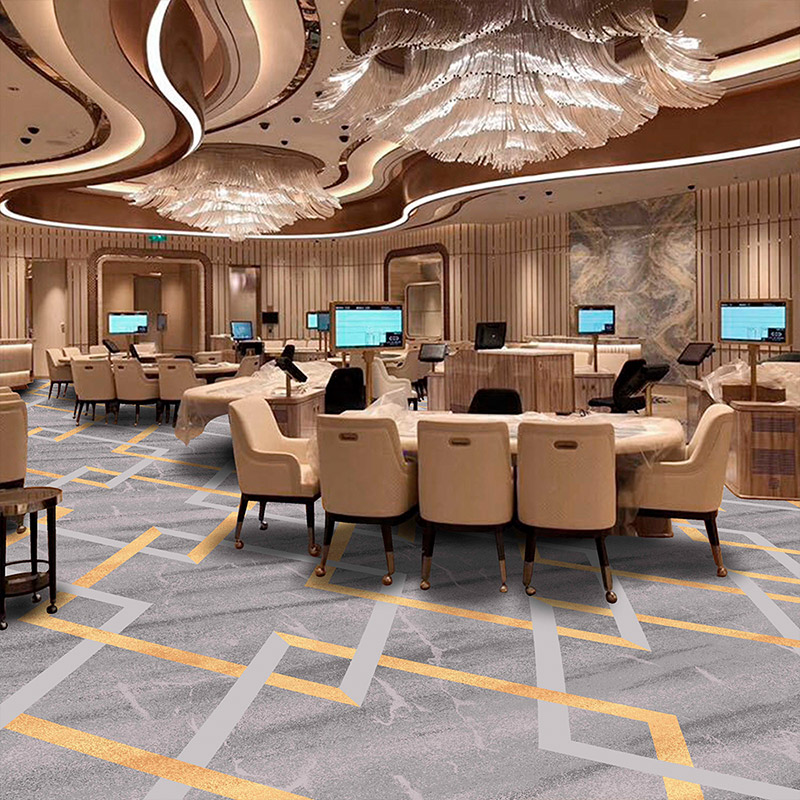
Understanding construction differences changes how you specify materials. The manufacturing method directly influences durability. It also affects pattern capabilities and long-term appearance retention. Let us compare the two leading hospitality technologies.
Woven construction defines this premium category. The loom weaves the backing and the surface pile simultaneously. They integrate into one single, cohesive structure. This traditional method completely prevents delamination. The layers simply cannot pull apart. It provides unmatched structural stability under extreme shear forces.
This makes Axminster carpet ideal for grand lobbies. Casinos and large ballrooms rely heavily on it. It supports highly complex, multi-color patterns. The dimensional stability lasts for decades. If you need sweeping, border-to-border designs, this is your primary choice. The initial investment yields massive longevity.
Tufting machines punch yarn into a primary backing. A secondary backing is then glued on for stability. When paired with Solution-Dyed Nylon (SDN), this method becomes incredibly powerful. SDN integrates color into the polymer melt before extrusion. The color goes entirely through the fiber. This creates extreme colorfastness. It will not fade easily under UV light.
This synthetic option is bleach-cleanable. It resists harsh chemical treatments perfectly. Tufted nylon also boasts rapid production times. It serves as a highly durable choice for guest rooms. Mid-tier property corridors also benefit greatly from it. It resists stains and cleans up quickly.
Material Comparison Breakdown
Feature | Axminster (Woven) | Tufted Nylon (SDN) |
|---|---|---|
Construction | Yarn and backing woven together simultaneously. | Yarn punched into backing, glued together. |
Ideal Spaces | Lobbies, casinos, grand ballrooms. | Guest rooms, standard corridors, meeting rooms. |
Durability Risk | Extremely low risk of delamination. | Moderate risk if poor quality adhesives are used. |
Stain Resistance | Natural resistance (wool blend), requires care. | High chemical resistance, bleach-cleanable. |
Design Capability | Unlimited colors, complex continuous patterns. | Standard repeating patterns, limited color per row. |
Buying commercial flooring requires careful project management. You rarely purchase these items off the shelf. Designing and ordering customized patterns takes time. You must understand production timelines. Managing factory requirements prevents project delays.
Producing custom designs begins with a strike-off. A strike-off is a small physical sample of your requested pattern. You should never approve a design based on digital renders alone. You must verify color accuracy under actual hotel lighting.
Most hospitality corridors use warm lighting between 2700K and 3000K. Colors shift dramatically under these warm temperatures. A grey yarn might look distinctly purple or green. Producing and shipping strike-offs takes about two to three weeks. Plan this into your master schedule.
Factories enforce Minimum Order Quantities for bespoke runs. Setting up looms or tufting machines requires significant effort. Ordering small batches is highly inefficient for manufacturers. You must understand how to bundle your spaces. Combining guest room orders across multiple floors helps meet these thresholds. When ordering custom hotel carpet, consolidate your color palettes. Using the same background yarn across different patterns reduces your MOQ burden.
You must calculate overage accurately. Complex patterns require larger pattern repeats. This creates more waste during installation. Additionally, you must purchase attic stock. We recommend holding 5-10% extra material in your inventory.
Dye-lots vary between production runs. If a pipe bursts next year, you need exact matching material. Ordering replacement pieces later guarantees a noticeable color difference. Secure your attic stock during the initial production phase.
Essential Procurement Steps:
Finalize the interior design renders and define space requirements.
Request technical specification sheets from the manufacturer.
Order physical strike-offs for your top two design choices.
Test strike-offs on-site under 2700K–3000K lighting conditions.
Calculate pattern match waste and add 5-10% for attic stock.
Sign off on the final bill of quantities and issue the purchase order.
Great materials fail without proper installation. You must follow strict engineering guidelines. Furthermore, hospitality spaces demand absolute safety compliance. Ignoring these rules invites severe legal and operational risks.
Fire safety stands above all other requirements. Commercial hospitality demands mandatory fire-retardant ratings. You must verify the Critical Radiant Flux (CRF). This measures how much heat it takes to sustain a flame. Materials must pass standard tests like ASTM E648 in the US. In Europe, they use EN 13501-1.
Smoke density testing is equally important. In a fire, thick smoke prevents guests from finding emergency exits. You must collect certified test reports from your manufacturer before installation. Never bypass these compliance checks.
How you attach the flooring matters immensely. There are two primary methods used in hospitality.
The "Stretch-in" method uses tack strips around the room edges. Installers stretch the material over a loose pad. This works adequately for guest rooms. However, it fails completely under wheeled traffic.
We highly recommend the "Double-Stick" method for corridors and public areas. Installers glue the pad directly to the subfloor. They then glue the carpet directly to the pad. This creates a monolithic, immovable structure. It eliminates bubbling and rippling. Luggage carts will not push the material forward over time.
Installation Methods Summary Chart
Installation Method | Application Process | Best Used For | Wheeled Traffic Rating |
|---|---|---|---|
Stretch-In | Tack strips at edges, stretched over loose underlay. | Guest Rooms only. | Poor. Prone to buckling. |
Double-Stick | Adhesive bonds floor-to-pad and pad-to-carpet. | Corridors, Lobbies, Event Spaces. | Excellent. Maximum stability. |
Direct Glue-Down | Adhesive bonds carpet directly to subfloor (no pad). | Service corridors, back-of-house. | Good, but lacks acoustic comfort. |
Corridors require multiple seams. Long hallways exceed standard manufacturing widths. Seam placement requires strategic planning. You must place seams away from direct light sources. Window light highlights seam shadows dramatically.
Furthermore, keep seams away from high-pivot areas. Elevator banks and sharp hallway corners experience intense twisting foot traffic. This twisting motion frays seams quickly. We advise sealing all seam edges with premium commercial seam sealer. This prevents the yarns from unraveling under heavy use.
What to watch out for: Seam peaking occurs when stretched seams lift slightly. Double-stick installation minimizes this risk entirely.
Navigating commercial hospitality flooring requires systematic planning. You must first define the specific demands of the space. Guest rooms need quiet comfort. Corridors demand heavy-duty abrasion resistance. Lobbies require undeniable structural stability. Always prioritize the fiber construction based on actual traffic volumes. Never compromise on fire compliance and mandatory safety testing.
For hotel developers, interior designers, and procurement teams looking for project-specific flooring solutions, LKHY provides a range of hospitality carpet options, including Axminster carpet, wall-to-wall carpet, and carpet tiles, along with customization support for colors, patterns, materials, and project requirements. Our team can work with you from design development and sample confirmation through production, helping ensure the selected carpet aligns with both the visual concept and practical demands of the hotel environment.
Finally, mandate proper installation methods. A premium woven material will still buckle if installed poorly. As a next-step action, we encourage procurement teams to request technical specification sheets immediately. Order physical strike-offs for your top two design choices. Verify these samples in your actual hotel lighting environment. Only then should you finalize your comprehensive bill of quantities.
A: High-density Solution-Dyed Nylon (SDN) and 80/20 wool-nylon blends dominate corridors. SDN provides extreme abrasion resistance and stands up to harsh chemical cleaners. Wool blends offer superior crush recovery against heavy rolling luggage carts.
A: Realistic B2B lead times typically range from 8 to 12 weeks. This timeline begins only after you approve the physical strike-off sample. Shipping logistics and factory scheduling play a major role in final delivery dates.
A: Double-stick installation glues the pad to the floor and the carpet to the pad. This prevents the material from buckling or rippling under the heavy pushing force of wheeled luggage carts and bellhop equipment.
A: Hallways require complex pattern matching. When you align large repeating designs side-by-side, you must cut away excess material. This pattern match repeat makes corridor wastage calculations significantly higher than standard square rooms.


