

| Color: | |
|---|---|
| Size: | |
| Fiber: | |
| Backing: | |
| Gauge: | |
| Construction: | |
| Total Thickness: | |
| Quantity: | |
Champion
LKHY

Champion is a commercial carpet tile designed for buyers looking for a practical balance between appearance, everyday use, and project cost.
The tile uses a multi-level loop construction with PP fiber, giving the surface a subtle textured effect instead of a completely flat appearance. The 50 × 50 cm modular format makes it suitable for common commercial floor layouts and allows individual sections to be handled separately during installation or future maintenance.
For contractors, distributors, project suppliers, and commercial flooring buyers, Champion is a straightforward option when the project requires PP carpet tiles, carpet squares, or modular carpet flooring without moving into a higher-cost fiber specification.
| Specification | Champion |
|---|---|
| Construction | Multi-level Loop |
| Face Fiber | PP (Polypropylene) |
| Gauge | 1/10" |
| Backing | Ecological |
| Pile Height | 4/3/2 + 0.5 mm |
| Tile Size | 50 × 50 cm |
| Product Type | Commercial Carpet Tiles |
| Installation Format | Modular Tile |
The 50 × 50 cm format is widely used in commercial flooring because it is easy to divide into installation areas and works well with conventional floor planning.
For a project buyer, the practical advantage is not simply the tile size. It is the ability to manage the floor in sections.
If a small area becomes damaged or heavily soiled, the maintenance team can deal with the affected tiles rather than removing an entire carpeted area. This can be particularly useful in offices, retail interiors, hospitality spaces, education facilities, and other areas where the floor remains in daily use.
The square format also makes it easier to combine different colors or installation directions when a project requires a more varied floor layout.
Champion uses a multi-level loop pile, where the loops are formed at different heights to create changes in surface texture.
This gives the carpet tile a more structured visual appearance than a completely level surface. It can help hide minor variations caused by normal daily use and gives designers another option when a plain, flat carpet surface is not the desired look.
For commercial interiors, this type of construction can work particularly well where the buyer wants a floor that looks understated but still has visible texture.
The face fiber of Champion is polypropylene (PP).
PP carpet tiles are often considered for projects where the buyer needs a practical commercial flooring material while keeping the overall flooring budget under control. Compared with premium nylon specifications, PP can be a more economical option for applications where extreme wear performance is not the primary requirement.
For procurement teams, the right fiber should be selected according to the actual project rather than simply choosing the most expensive material.
Factors such as:
expected daily foot traffic
cleaning frequency
project budget
required appearance
replacement expectations
installation environment
should all be considered before confirming the carpet tile specification.
For particularly demanding heavy-traffic areas, buyers may also compare PP carpet tiles with nylon carpet tiles before making the final selection.
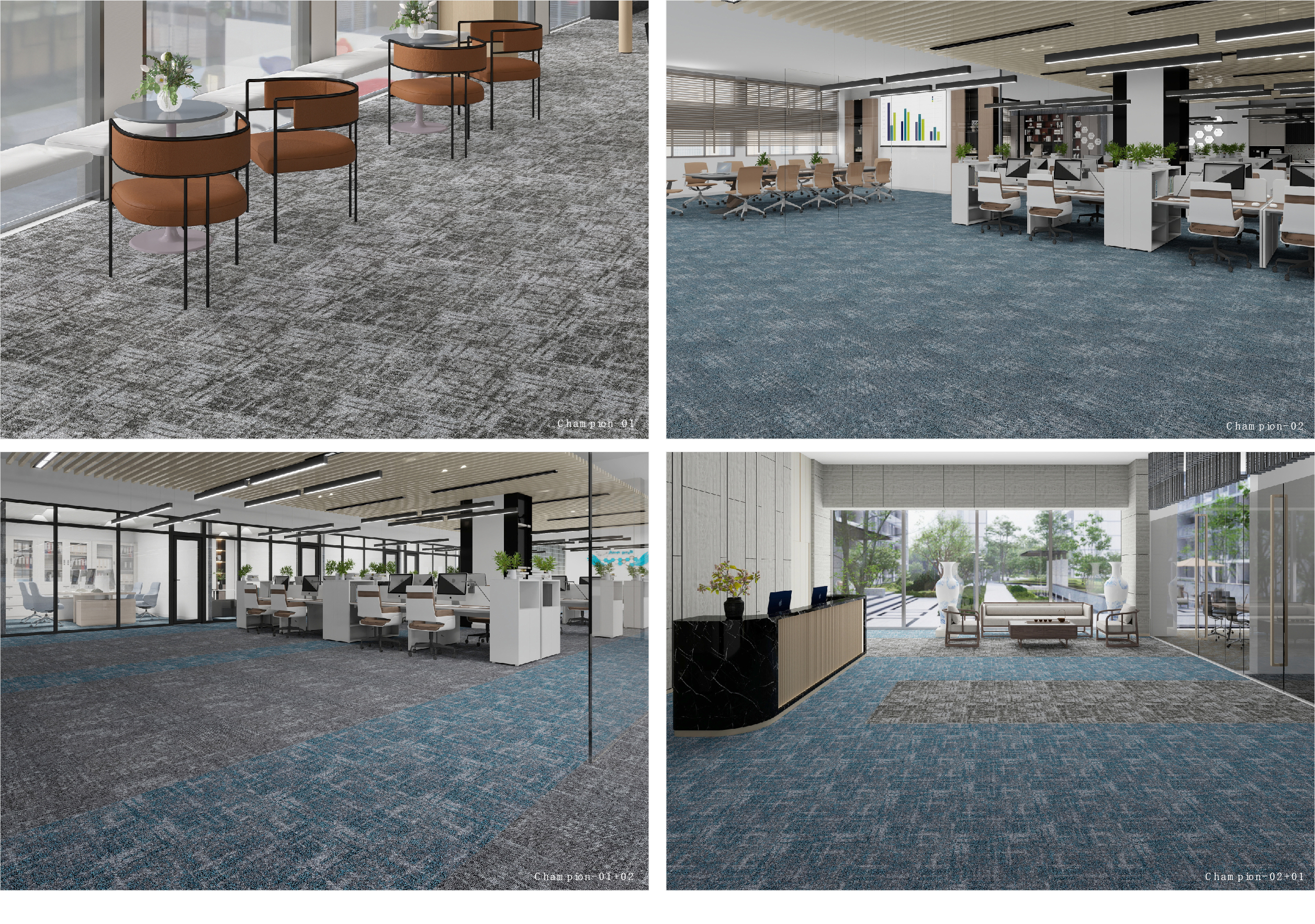
Champion uses an Ecological backing system.
The backing is an important part of a carpet tile because it affects how the tile behaves during handling, installation, and everyday use. For project procurement, backing should therefore be reviewed together with the face fiber and pile construction instead of evaluating the carpet surface alone.
Different projects may require different backing systems. Depending on the product series and project requirements, carpet tiles can also be developed with backing options such as PVC, bitumen, PE, or PU.
For buyers requesting a customized commercial carpet tile, the backing can be discussed according to the intended application, installation conditions, transportation requirements, and target budget.
Champion's 50 × 50 cm format makes it suitable for a range of commercial interiors where modular flooring is preferred.
Typical applications may include:
Office carpet tiles
Commercial buildings
Retail spaces
Meeting rooms
Education facilities
Hotel public areas
Hospitality interiors
Showrooms
Corridors and circulation areas
General commercial flooring projects
The final suitability should always be assessed according to the project's traffic level, maintenance conditions, local building requirements, and installation environment.
For B2B buyers, purchasing carpet tiles is different from buying residential floor coverings.
A project order normally involves more than selecting a color from a catalog. Buyers may need to confirm:
Tile size:
50 × 50 cm is a practical modular format for many commercial layouts.
Fiber:
PP is suitable for projects where cost control and everyday commercial use are important considerations.
Construction:
Multi-level loop provides a textured surface and a distinctive visual effect.
Backing:
The backing specification should match the project's installation and performance requirements.
Quantity:
Project quantities should be calculated according to the actual floor area, installation pattern, cutting requirements, and spare tiles required for future maintenance.
Color and design:
For larger projects, buyers can discuss available colors, patterns, and customized designs with the supplier.
This approach helps avoid choosing a carpet tile based only on appearance or unit price.
For wholesalers, distributors, contractors, and project suppliers, bulk carpet tile purchasing requires stable specifications and consistent production.
Before placing a large order, it is useful to confirm:
Product model and construction
Fiber material
Tile dimensions
Backing type
Pile height
Color and pattern
Packaging requirements
Required quantity
Delivery schedule
Sample approval
Inspection requirements
For large commercial flooring projects, the approved sample should be used as the reference for subsequent production wherever applicable.
This is especially important when several batches are required for the same project.
Not every commercial project needs an off-the-shelf carpet square.
For projects with specific design or technical requirements, buyers can discuss customized options such as:
Carpet tile colors
Surface patterns
Fiber selection
Backing system
Tile dimensions
Pile construction
Thickness
Packaging
OEM requirements
Customization is generally more practical when the project quantity is sufficient to support dedicated production.
For distributors and flooring companies, customized carpet tiles can also be developed around their own market requirements rather than using exactly the same specification as a standard product.
Carpet tile installation should begin with a clean, dry, level, and structurally sound subfloor.
For commercial projects, installers normally need to pay attention to:
Subfloor condition – uneven or damaged surfaces should be addressed before installation.
Tile direction – the installation direction can affect the final visual effect.
Pattern alignment – patterned carpet tiles require careful positioning to maintain the intended appearance.
Adhesive system – the adhesive or installation method should be compatible with the selected backing and site conditions.
Expansion and movement – the installation plan should account for the characteristics of the existing floor.
Batch consistency – tiles from different production batches should be checked before installation.
For larger commercial projects, professional installation is recommended because installation quality can have a direct effect on the finished appearance and service performance.
One of the practical reasons commercial buyers choose carpet squares instead of broadloom carpet is the ability to manage the flooring in smaller sections.
Routine maintenance generally includes regular vacuuming and cleaning according to the carpet manufacturer's recommendations.
If an individual tile becomes badly stained or damaged, it may be possible to replace that tile rather than replacing a much larger section of flooring.
For facility managers, this can simplify maintenance planning, especially in offices, retail spaces, and other interiors that cannot easily be taken out of service for major flooring work.
Keeping a small quantity of approved spare tiles after installation can also be useful for future repairs.

If you are sourcing commercial carpet tiles wholesale or purchasing carpet squares for a construction project, we recommend confirming the following information before requesting a quotation:
Office, hotel, retail, education, public building, showroom, or another application may require different specifications.
A low-to-medium traffic office may not require the same fiber specification as a busy public circulation area.
PP can be considered for cost-conscious commercial projects, while nylon may be preferred when higher wear performance is a priority.
Backing should be selected according to installation conditions, project requirements, and budget.
If standard colors and specifications meet the project requirements, purchasing an existing product can simplify the process. Customization may be considered when the project has specific design or technical requirements.
For project orders, sample approval is recommended before mass production so the buyer, designer, contractor, and end client have a clear reference.
Champion can be considered for office and general commercial interiors where a 50 × 50 cm PP carpet tile with a textured multi-level loop surface fits the project's requirements.
The standard Champion tile size is 50 × 50 cm.
Champion uses PP (polypropylene) face fiber.
Multi-level loop means the carpet surface contains loops formed at different pile heights. This creates a subtle variation in texture and appearance.
PP can be a practical choice for commercial projects where cost control and normal commercial use are important considerations. For very demanding traffic conditions, buyers should compare PP with higher-performance fiber options such as nylon.
Yes. Depending on the project quantity and requirements, buyers can discuss customized colors, designs, fiber, backing, dimensions, and other specifications.
Yes. Bulk carpet tile orders can be discussed for wholesalers, distributors, contractors, and commercial flooring projects. The final quotation depends on product specification, quantity, customization, packaging, and shipping requirements.
In many installations, individual carpet tiles can be removed and replaced. This is one of the practical advantages of modular carpet flooring compared with replacing an entire broadloom carpet section.
Yes, carpet tiles are commonly considered for commercial projects because the modular format allows the flooring to be divided into manageable sections. The appropriate product should still be selected according to traffic, maintenance, installation conditions, and project specifications.


